In November 1920, thousands of women wrote to the government asking to join the ceremony at Westminster Abbey for the Unknown Warrior. Each of them was convinced that he was her son.
It’s a story that stops you in your tracks. It’s also, I expect, one you never heard at school. Our young team found it while asking a simple question: what did the First World War do to women’s mental health?
With Remembrance Sunday 2026 on 8 November and Armistice Day on Wednesday 11 November, many of you will be planning lessons, assemblies and tutor time right now. If you’d like to take a different angle this year, or start something bigger with your students, we have just the thing. We Are Poppy is a free set of Remembrance resources for secondary schools, exploring how the First World War affected women’s mental health.
What is the We Are Poppy project?
We Are Poppy explores how the First World War affected women’s mental health. It was developed in 2020 by young people aged 14 to 19 from Hove Park School, the East Sussex Youth Cabinet and the Make (Good) Trouble team, with support from the National Lottery Heritage Fund.
Our team knew about soldiers and shellshock, but the women’s side of the story was new to them. As Amelie, 14, told us, “it hadn’t even occurred to me that the women would get shellshock”.
Then the pandemic lockdown hit, and planned archive visits were cancelled. So the team went digging online instead. They found Mabel Lethbridge, a 17-year-old munitions worker who lost a leg in a factory explosion. They read about nurses at the front who were simply sent home when they showed signs of what we’d now call PTSD.
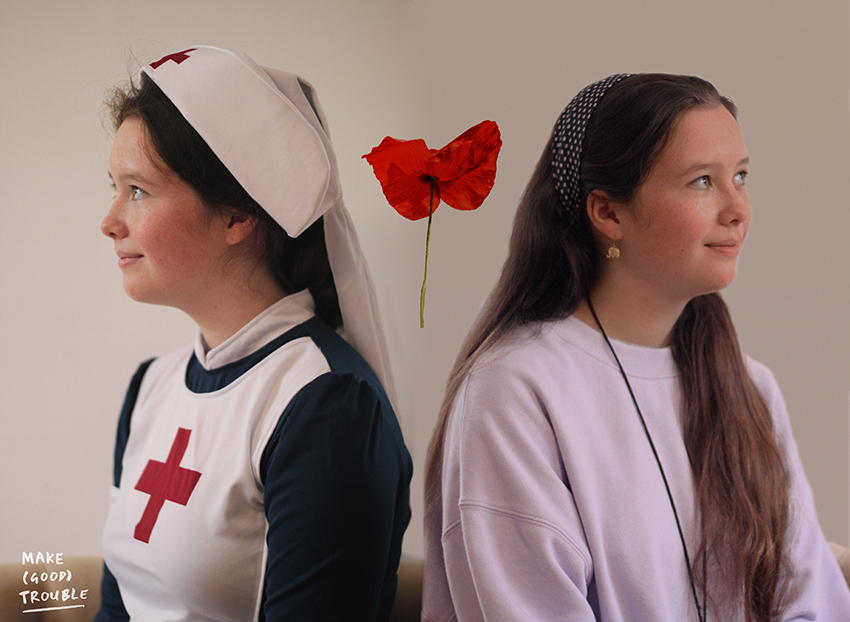
To make sense of it all, they invented Poppy, a fictional young woman living through the war. Imagining her life helped them connect with the real women they were reading about. It all came together in Dear Poppy, a podcast that imagines a conversation between today’s teenagers and the young women of 1914-18 – women who fought, nursed and kept the home fires burning. It was broadcast on BBC Radio Sussex and BBC Radio Surrey on Remembrance Sunday 2020.
Listen to the We Are Poppy podcast
What resources are available for schools?
Everything lives on wearepoppy.org, so you can dip in for one lesson or use the lot. It also works well for Women’s History Month or Mental Health Awareness Week.
A great place to start is the 29-minute podcast, which mixes letters, diaries, medical records and expert interviews. You’ll also find full interviews with historian Professor Lucy Noakes, historian and therapist Denise Poynter, and trauma therapist Darren Abrahams.
For classroom planning, download our Schools Pack. It’s free to download, aimed at secondary-age students and has five lessons:
- Introduction and podcast: meet the project and listen to Dear Poppy.
- Life in the First World War: explore women’s lives through seven real stories.
- Shining a light on mental health: look at trauma and shellshock, then and now.
- Recreating Poppy in the classroom: build a character and write letters across time.
- Make your own podcast: turn the research into audio.
A quick note before you start: the material covers trauma, loss and serious injury, and one section of student writing touches on sexual assault and harassment. It’s worth reading and listening first.
How to create a student research podcast about WW1
This is the bit we’re most excited about, because the site gives you what you need for students to make their own version. You don’t need a studio, either. Our team made Dear Poppy entirely remotely, recording on mobile phones and over video calls.
Here’s one way to do it:
- Create your Poppy. Students decide who she is, where she lives and what she did during the war, using our Poppy worksheet.
- Do the research. Our resources page points to the Imperial War Museum, The National Archives, The British Newspaper Archive and nurses’ diaries online. Local archives are great for finding women from your own area.
- Write to Poppy. Students write a letter to Poppy, then reply in her voice. This activity really fired up our team, and it’s a lovely standalone task if you only have one lesson.
- Shape the story. Start with the audience, then plan a beginning, middle and end. It could be a drama, a series of interviews, a group conversation or a mix.
- Record it. Students can interview each other, a historian or a relative with a family story, then add their own sound effects. Our podcast guide has tips on interviewing and recording, plus links to sound effect libraries.
The sound effects can be a highlight. When our sound editor, Alvy Vincent, needed the noise of injured men on a hospital ward, the answer was some home-recorded groaning, tucked quietly into the background. It seems a bit silly, but it’s surprisingly effective!
Share your students’ work
Jane Griffin, the retired teacher who worked with our team, says one of the joys of teaching is offering “a germ of an idea” and watching students take it somewhere you never imagined. That’s exactly what happened with Poppy.
So this Remembrance, why not ask your students who their Poppy might be? Have a look around wearepoppy.org, download the Schools Pack (PDF) and see where it takes you.
If you do make something, please get in touch. We’d love to feature your students’ work on the website. And if you’d like a hand, we also run creative and media workshops for young people.
Frequently asked questions
Who are the We Are Poppy resources for?
The Schools Pack is aimed at secondary-age students, and the website is open to anyone who wants to explore women’s experiences of the First World War.
Do you need special equipment to make a podcast?
No. Our team recorded on mobile phones and over video calls, then edited the audio together with software. Headphones help you check the sound as you record, and a furry windshield is useful outdoors.
Can students use the resources outside Remembrance?
Yes. The lessons explore women’s history, mental health and storytelling, so they work at any time of year.