In November 1920, thousands of women wrote to the government asking to join the ceremony at Westminster Abbey for the Unknown Warrior. Each of them was convinced that he was her son.

It’s a story that stops you in your tracks. It’s also, I expect, one you never heard at school. Our young team found it while asking a simple question: what did the First World War do to women’s mental health?

With Remembrance Sunday 2026 on 8 November and Armistice Day on Wednesday 11 November, many of you will be planning lessons, assemblies and tutor time right now. If you’d like to take a different angle this year, or start something bigger with your students, we have just the thing. We Are Poppy is a free set of Remembrance resources for secondary schools, exploring how the First World War affected women’s mental health.

What is the We Are Poppy project?

We Are Poppy explores how the First World War affected women’s mental health. It was developed in 2020 by young people aged 14 to 19 from Hove Park School, the East Sussex Youth Cabinet and the Make (Good) Trouble team, with support from the National Lottery Heritage Fund.

Our team knew about soldiers and shellshock, but the women’s side of the story was new to them. As Amelie, 14, told us, “it hadn’t even occurred to me that the women would get shellshock”.

Then the pandemic lockdown hit, and planned archive visits were cancelled. So the team went digging online instead. They found Mabel Lethbridge, a 17-year-old munitions worker who lost a leg in a factory explosion. They read about nurses at the front who were simply sent home when they showed signs of what we’d now call PTSD.

To make sense of it all, they invented Poppy, a fictional young woman living through the war. Imagining her life helped them connect with the real women they were reading about. It all came together in Dear Poppy, a podcast that imagines a conversation between today’s teenagers and the young women of 1914-18 – women who fought, nursed and kept the home fires burning. It was broadcast on BBC Radio Sussex and BBC Radio Surrey on Remembrance Sunday 2020.

Listen to the We Are Poppy podcast

What resources are available for schools?

Everything lives on wearepoppy.org, so you can dip in for one lesson or use the lot. It also works well for Women’s History Month or Mental Health Awareness Week.

A great place to start is the 29-minute podcast, which mixes letters, diaries, medical records and expert interviews. You’ll also find full interviews with historian Professor Lucy Noakes, historian and therapist Denise Poynter, and trauma therapist Darren Abrahams.

For classroom planning, download our Schools Pack. It’s free to download, aimed at secondary-age students and has five lessons:

  1. Introduction and podcast: meet the project and listen to Dear Poppy.
  2. Life in the First World War: explore women’s lives through seven real stories.
  3. Shining a light on mental health: look at trauma and shellshock, then and now.
  4. Recreating Poppy in the classroom: build a character and write letters across time.
  5. Make your own podcast: turn the research into audio.

A quick note before you start: the material covers trauma, loss and serious injury, and one section of student writing touches on sexual assault and harassment. It’s worth reading and listening first.

How to create a student research podcast about WW1

This is the bit we’re most excited about, because the site gives you what you need for students to make their own version. You don’t need a studio, either. Our team made Dear Poppy entirely remotely, recording on mobile phones and over video calls.

Here’s one way to do it:

  1. Create your Poppy. Students decide who she is, where she lives and what she did during the war, using our Poppy worksheet.
  2. Do the research. Our resources page points to the Imperial War Museum, The National Archives, The British Newspaper Archive and nurses’ diaries online. Local archives are great for finding women from your own area.
  3. Write to Poppy. Students write a letter to Poppy, then reply in her voice. This activity really fired up our team, and it’s a lovely standalone task if you only have one lesson.
  4. Shape the story. Start with the audience, then plan a beginning, middle and end. It could be a drama, a series of interviews, a group conversation or a mix.
  5. Record it. Students can interview each other, a historian or a relative with a family story, then add their own sound effects. Our podcast guide has tips on interviewing and recording, plus links to sound effect libraries.

The sound effects can be a highlight. When our sound editor, Alvy Vincent, needed the noise of injured men on a hospital ward, the answer was some home-recorded groaning, tucked quietly into the background. It seems a bit silly, but it’s surprisingly effective!
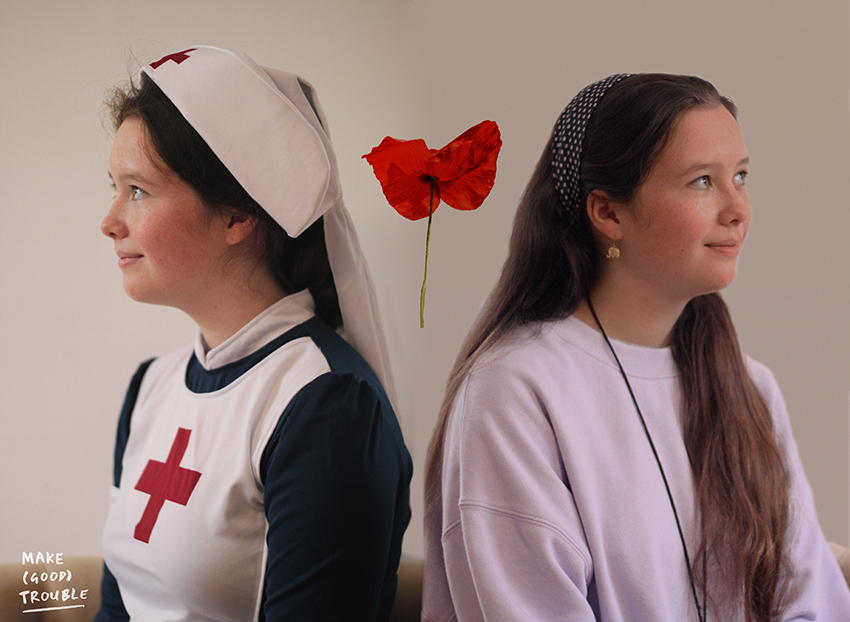
Teen in First World War and modern dress, from the photoshoot for We Are Poppy - commemorating women in WW1

Share your students’ work

Jane Griffin, the retired teacher who worked with our team, says one of the joys of teaching is offering “a germ of an idea” and watching students take it somewhere you never imagined. That’s exactly what happened with Poppy.

So this Remembrance, why not ask your students who their Poppy might be? Have a look around wearepoppy.org, download the Schools Pack (PDF) and see where it takes you.

If you do make something, please get in touch. We’d love to feature your students’ work on the website. And if you’d like a hand, we also run creative and media workshops for young people.

Frequently asked questions

Who are the We Are Poppy resources for?

The Schools Pack is aimed at secondary-age students, and the website is open to anyone who wants to explore women’s experiences of the First World War.

Do you need special equipment to make a podcast?

No. Our team recorded on mobile phones and over video calls, then edited the audio together with software. Headphones help you check the sound as you record, and a furry windshield is useful outdoors.

Can students use the resources outside Remembrance?

Yes. The lessons explore women’s history, mental health and storytelling, so they work at any time of year.
At the end of 2024, we held two podcasting workshops for young people as part of the Coastal Catalyst project. Together with students, we explored the art of interview techniques and guided them in crafting their very own podcast – turning their ideas into compelling stories. We hope you enjoy listening to their stories…

Teen Tunes, a podcast created by Freya and Ben, is a delightful dive into the roots of their passion for music.

The Things We’re Passionate About is a podcast created by media students from Brighton Aldridge Community Academy. It focuses on a number of big issues they care about: from bringing more colour into our city and better buses to the cost of living, the minimum wage, women’s rights, litter and secure housing.

These podcasts were created with the help of Make (Good) Trouble. Coastal Catalyst is supported by Future Creators, Brighton Dome, Talent Accelerator and Arts Council England.

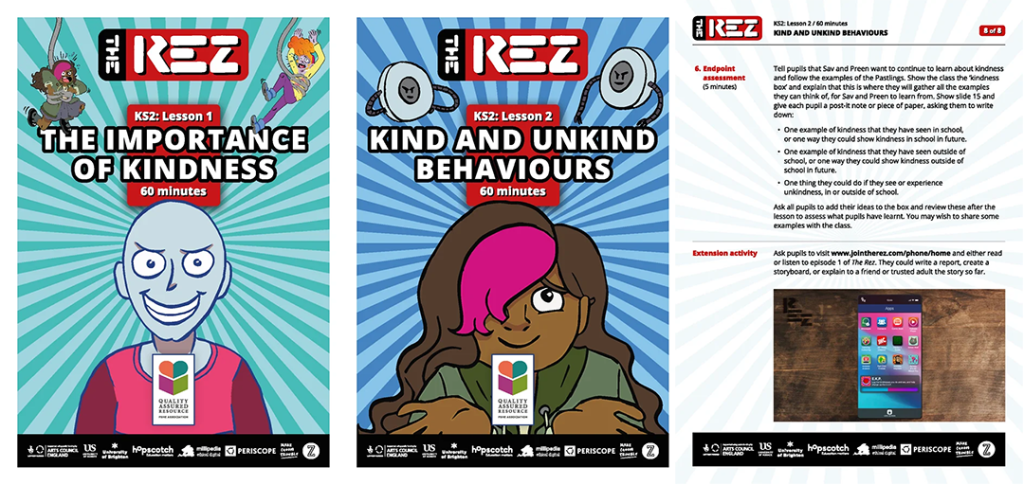
The Rez is an exciting collaboration between academics at the University of Sussex, Make (Good) Trouble and Arts Council England. It is a sci-fi podcast adventure for 7–11-year-olds told through a comic book and a game-based website, designed to help young people prepare to negotiate emotional difficulties and stresses. The Rez is created by recent UK Comic Laureate Hannah Berry, alongside a team of writers and psychologists. 

Make (Good) Trouble was engaged to produce content to raise awareness of The Rez, including a Key Stage 2 lesson pack, Quality Assured by the PSHE Association, which has now been updated to include alternative options for pupils with Special Educational Needs and Disabilities (SEND). Over 1.5 million children have special educational needs, according to government statistics – an increase of 87,000 on 2022. 

Teaching about kindness supports pupils with SEND in meeting learning outcomes around ‘Self Awareness’, as outlined in the PSHE Association’s Planning Framework, and helps teachers to cover statutory content about ‘Caring friendships’ from the Department for Education’s RSHE guidance. You can find more about teaching safe and effective PSHE education for pupils with SEND on the PSHE Association’s website. There’s also a super-useful teacher’s handbook for embedding inclusive practice around SEND in schools.

We felt it was important for to work with the University of Sussex and the PSHE Association to develop guides and lesson plans that include pupils with SEND. We work with a lot of young people who have additional needs, and it’s great to offer more practical support and visually engaging content to enhance their experience in the classroom.

“We were delighted to work with The Rez and Make (Good) Trouble on this project. The story and bright visual aspects of these lesson plans will help teachers appeal to pupils’ imagination throughout and help them to explore the topic of kindness a fun and engaging way.” 
 Liz Laming, Senior Subject Specialist, PSHE Association.

“Working with Make (Good) Trouble to develop lesson plans for our PSHE Association-accredited adolescent well-being project has made all the difference to our outreach. It has literally opened the doors to hundreds of schools for us. This means potentially thousands of students are being resourced to support their own mental health and to have healthier media diets. Our impact would have been a fraction of what it is without Make (Good) Trouble. We are working with them on a second set of lesson plans and look forward to working with them on new projects we are developing. They are great!” 
Martin Spinelli, Professor of Podcast at the University of Sussex and Director of Rezilience Ltd.

Get in touch if you’d like us to support you with the development and distribution of PSHE education lessons.

👉 Download the lesson plans here!

👉 jointherez.com

“I’ve just listened to the Raising Teens Neurodiversity podcast and it’s absolutely fantastic. I’m really enjoying listening to the advice from the panel as well as other young people’s own thoughts and feelings that are similar to my own. I also listened to the Trauma podcast and I’m in tears hearing what the panel had to say about my own story and just hearing it back. I can’t put into words how brilliant this show is and I hope more people can hear it because it could be life-saving for someone going through something similar!” 

This lovely quote is from one of the young people who shared their story with us for our BBC podcast, Raising Teens, which was broadcast in January and February. We hope you’ve enjoyed the series. In our last newsletter, we promised to send you links to our final two episodes, and here they are:

Raising Teens: Neurodiversity
Whilst neurodiversity isn’t a mental health condition, many children and young people experience challenges with their mental health. This episode of Raising Teens brings experts together to look at the experiences of neurodivergent young people and how families can support their children so they can develop and thrive. We also look at what role getting a diagnosis plays in that. We hear from young people about the social pressures they face to behave ‘appropriately’ – or like their neurotypical peers – at school, in friendship groups, and communities and how coping strategies can take a huge toll on their emotional wellbeing.

🎧 Listen to Raising Teens: Neurodiversity on BBC Sounds 
👋 More information about this episode and links to support
 
Raising Teens: Support in Schools
In our final episode of series five, we look at what mental health support is available in schools. Long-term, children and young people who struggle with their mental health are more likely to have poorer physical health and economic outcomes than their peers. So we discuss how schools can help to improve the outlook for our young people, what help they’re entitled to, and whether schools are equipped to provide that support and help prevent the need for clinical treatment. It’s not known how many children are educated at home, but in a recent report from Schools Week, they estimate that there has been a rise of 60% since the pandemic. What support can home-schooled young people expect?

🎧 Listen to Raising Teens: Support in Schools on BBC Sounds 
👋 More information about this episode and links to support
 
🎧 Catch up on all episodes from Series 5.
🎧 Plus you can catch up with previous series of Raising Teens – covering everything from social media and loneliness to county lines and the teenage brain… 
 
Make (Good) Training!
We’re rolling out new training sessions for young people to help with their self-confidence and communication skills. Interview Skills and Techniques will help young people to walk into a room and feel empowered to have a meaningful conversation with anyone. These workshops are driven by a desire to help build social skills in young people after a marked decline in recent years. 42% of parents of 12-15 year-olds reported a decline in their child’s social and emotional development, with 4-7 year-olds faring even worse at 52%, according to a report by the Institute for Fiscal Studies. Social skills are seen as increasingly important in a future driven by automation in the workplace. We want to help young people get ahead of the curve.  
If your organisation is interested in finding out more about our Interview Skills Training workshops, get in touch!
 
Drama workshops this Easter
We’re running drama workshops this Easter in collaboration with the brilliant team at Dragon Drama. It’s all part of East Sussex’s Holiday Activities and Food programme and places are free to children in receipt of free school meals. Registration opens on Monday 11 March, and you’ll be able to sign up for the club via this link next Monday.
 
Work with us!
If you’re interested in working with us – collaborate on new or current initiatives, partner with us, fund or donate to our programmes, we have a band new webpage with all the details: Work With Us!

👋 Do share this blog with anyone you think might find it useful. Thanks! 
 
We hope you enjoy Make (Good) News. If you have any suggestions or news you think we should cover next month, send us a line! 

The Make (Good) Trouble team x