
Here comes a news story that touches your cause, followed, with a few hours’ notice, by a media request. If your youth ambassadors are ready to comment, your charity gets heard, and so do they. If they aren’t, the moment goes to someone else.
We’ve been getting more charities asking us to run media training for their youth ambassadors, so I thought it would be a good time to write about what we do and why it’s worth doing.
What is youth ambassador media training?
Make (Good) Trouble’s media training is a hands-on workshop that prepares charities’ youth ambassadors for press, broadcast and social media interviews. Workshops run from a single two-hour session to a series, for groups of up to 15 young people, and we deliver them across England. So far, we’ve worked with ambassadors aged 14 to 25.
Why do young people find media interviews hard?
Your ambassadors have something important to say, and often something personal. That doesn’t make it easy to say it to a journalist, on camera, with no second take.
It isn’t easy for most young people. When the National Literacy Trust surveyed more than 105,000 UK 8 to 18-year-olds in 2025, only four in ten said they felt good at speaking in front of an audience. Employers see it too. In the Institute of Student Employers’ 2025 survey, 42% said school and college leavers fell short on verbal communication, up from 22% just two years earlier.
That’s not a failing in young people. They’ve had fewer chances to practise. This is a generation that grew up messaging more than calling, lost face-to-face time to the pandemic, and went through schools where the opportunity to do drama and spoken English have been declining. (See also the National Literacy Trust’s report, Children. and Young People’s Speaking and Listening in 2025.)
And it turns into a loop:
- Speaking up makes you anxious, so you avoid it.
- Because you avoid it, you never get the practice.
- Without the practice, the next time feels even harder.
Practice is what breaks the loop. Make (Good) Trouble’s media training gives youth ambassadors that practice, somewhere safe, with people on their side.
What do youth ambassadors learn in media training?
Make (Good) Trouble’s media training workshops are hands-on from start to finish. Over a session, youth ambassadors will:
- Work out what they want to say. They start with your campaign, and their story, and frame how they want to talk about it.
- Learn how interviews work. The different types, how to listen, what body language says, and how to ask good questions as well as answer them.
- Try every role. If numbers and time allow, everyone takes a turn as producer, interviewer and interviewee, using professional audio kit or speaking in front of the group.
- Practise under pressure. ‘As live’ interviews with no retakes, so they learn to keep going after a stumble.
- Find their voice. Coaching on how to shape their stories, keeping a focus on what they want to say, and ways to handle nerves and the unexpected.
- Take it with them. We finish by looking back at what they’ve learned, with follow-up guidance that can include CV support.
These are skills for life as much as for media. A young person who learns to handle a live interview at 17 takes that into every job interview that follows.
What does your charity get out of it?
- You can say yes. Media requests rarely come with much notice. If your ambassadors have already practised, you can take the opportunity when it arrives.
- Your message lands. Ambassadors who know what the campaign is trying to achieve can put it across in their own words, which is what makes people listen.
- They get their point across, whatever the question. Interviewers don’t always ask about the thing your ambassadors came to say. It’s a question we hear a lot from the young people we’ve worked with, and we help them make their point anyway.
- You’ve looked after them. Putting a young person in front of a journalist unprepared isn’t fair on them. Our workshop students have already rehearsed what to do when a question throws them.
- They can front your own content too. The same skills work for your social media, films and events.
- You give something back. Your ambassadors give you their time and their stories. This sends them away with skills and confidence they’ll use long after the campaign.
How does the training work, and who runs it?
We shape every workshop around your campaign and your young people. Sessions can cover interview techniques, public speaking, fronting social media content and more.
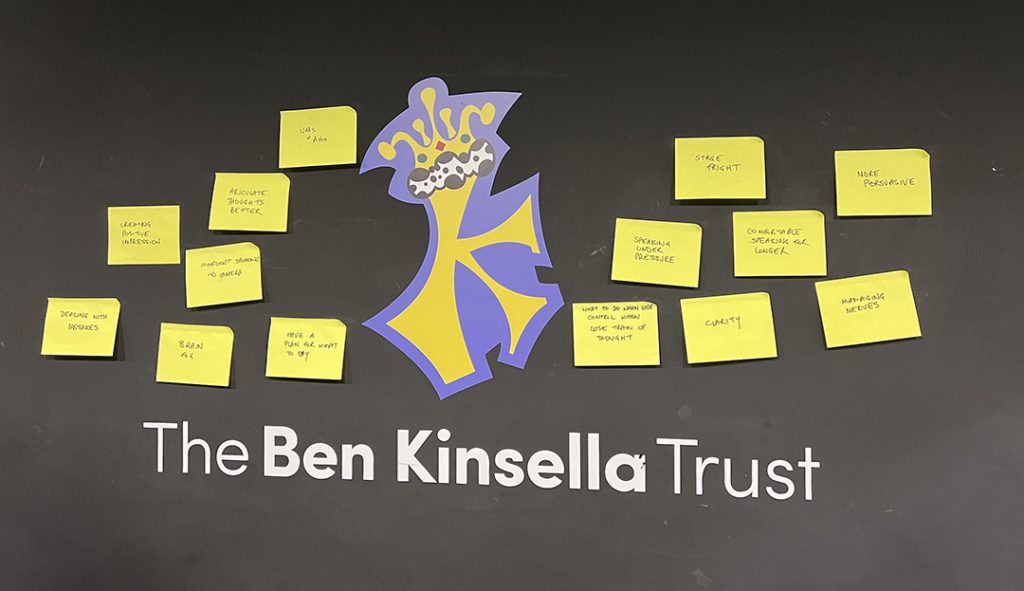
We’ve delivered media and interview training for youth ambassadors at the Ben Kinsella Trust, for work experience students at Wakehurst, and for students at The Horsfall, part of the 42nd Street charity. As the Ben Kinsella Trust put it, their ambassadors “gained valuable knowledge and skills to support their future careers”.
Workshops are led by our co-founders, Daisy Cresswell and me. We bring years of media, journalism and public speaking experience. All our team hold advanced DBS certificates.
Youth ambassador media training: FAQs
How long is a media training workshop?
Anything from a single two-hour session to a series of workshops. We shape the length and content around your campaign and your young people.
What age group is it for?
Make (Good) Trouble has run media training for young people aged 14 to 25, and we can be flexible.
How many young people can take part?
Up to 15 in each workshop.
Where do you run workshops?
We deliver media training across England. So far we’ve run workshops in Sussex and Manchester, with Birmingham coming up.
How much does it cost?
The cost of a Make (Good) Trouble media training workshop depends on what you need: the length of the session, how much preparation is involved, the materials, and how many young people are taking part. The easiest thing is to get in touch and tell us what you have in mind. We’ll talk it through with you and give you a price.
Do youth ambassadors need any media experience?
No. We start with the basics of how interviews work and how to use the equipment, so nobody needs to have done this before.
What if an interviewer doesn’t ask about the thing they want to say?
This is one of the questions we hear most from the ambassadors we’ve worked with. Our training helps young people get their point across even when the question isn’t the one they were hoping for.
How do you look after young people who are sharing personal stories?
Make (Good) Trouble’s workshops are run as a safe, supportive space, with emotional support alongside the practical training. We carry out a risk assessment for every workshop, and we ask you to share any access or support needs in advance so we can plan the session around them. It often helps if a trusted adult from your organisation attends – one the young people already know, so they feel at home. All our team hold advanced DBS certificates.
If you’d like your youth ambassadors ready before the next media request arrives, get in touch. We’d love to hear what they need.