
Gemma spoke about grief and loss on Raising Teens  last year. Here she talks about how that experience has helped her to open up and seek support.

It seems in a world so digitalised we often lose sight of reality; words are said with little truth behind them and conversations go unspoken. 

Make (Good) Trouble has initiated that conversation; discussing topics that are so often pushed aside, avoided, or even feared. It was for that exact reason that I’m determined to speak about the avoided, feared or pushed aside as these are normalities that are made anomalies. Having understood the topics at hand to be discussed, I was initially reluctant in opening up about the state of beings that I am far too familiar with; grief, loneliness and social anxiety. These three states of being tend to be intertwined and when one is taking the limelight the other two tend to sneak up slowly behind. 

After losing my mum at the age of nine and entering the foster care system at 14, I think it’s fair to say that adapting to change is now a skill I am far too familiar with. Anyone who has experienced a loss at such an age would understand when I say, the years that soon follow on from this are the ones you wished them were around to see; the start of secondary school, prom, birthdays and just general adolescent changes. I suppose losing a parent at any age is the greatest loss one can ever experience and as I said in my Raising Teens interview, I know as life progresses, there’ll be times when my mum is the only person I wish to share these moments with. 

We’ve heard from some amazing teens on the latest series of #RaisingTeens. This is Gemma talking about her mum. You can catch up on all the episodes via https://t.co/RYvFHBTVZb pic.twitter.com/GPHFTWLTp3— Make (Good) Trouble (@makegoodnews) 8 January 2020

The labels and judgement associated with foster care and losing a parent previously led me to avoid all conversations about it completely. While socially I would laugh and joke the situation away, internally the feeling was completely different. Make (Good) Trouble has helped me to break out of that mindset, to speak more openly and expose my vulnerabilities. 

Now, seven years on from where it all started, I’ve realised that I speak about my experiences for no other satisfaction than my own. To show pride in my determination to achieve all that my heart desires in aid of my mum’s legacy, and for those that are reading this, I urge you to do the same. I’m a firm believer that everything happens for a reason, a destined outcome is there for the taking if you’re willing to work hard enough for it and neither your past nor surroundings should determine the outcome of that. 

My message here is simple; communication is key. Often talking can be the initiating factor behind that new friendship you never saw coming, the factor that resolves that argument that you no longer remember how it started. And it can be the beginning of the process that eventually heals, in some way, the wounds you’ve long tried to hide away from. 

I want to thank the Make (Good) Trouble team for providing me with the platform to open up on and for allowing me to share my experiences with a purpose to allow others to do the same. 
Listen to Raising Teens: Grief

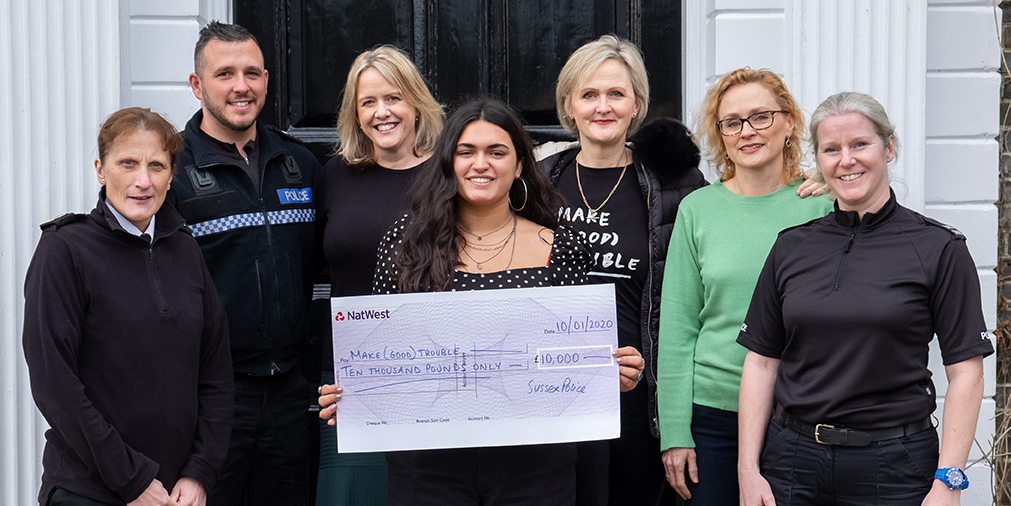
Make (Good) Trouble is delighted to have been awarded a £10,000 donation from Sussex Police through the Police Property Act Fund (PPAF). This is made up of monies received by the police from property confiscated by order of the courts and then sold. Sussex Police has been hugely supportive of our work from the outset and this funding will help us to continue building on the success of our BBC Sussex and BBC Surrey radio series Raising Teens. The money will go towards the development of an online hub where parents and carers can feel included and supported with easy access to practical help and where they can gain a better understanding of teenage emotional and mental health issues.

The cheque was presented to Make (Good) Trouble’s teen reporter, Lola Ray by Chief Superintendent Jane Derrick.

L to R Jane Derrick, Jan Szaranek, Jane Keating, Lola Ray, Daisy Cresswell, Tayler Cresswell, Claire Kilroy
L to R Chief Superintendent Jane Derrick, Sergeant Jan Szaranek, Jane Keating, Lola Ray, Daisy Cresswell, Tayler Cresswell and PC Claire Kilroy

Feedback on the latest series of our BBC Sussex radio show Raising Teens has been amazing and the feedback we love the most if from teens who have contributed to the show. This is from Gemma who talked movingly on Raising Teens about losing her mum, loneliness and grief. On her Instagram post, Gemma called it “a heartbreaking yet necessary conversation” about grief and loneliness.

“Raising teens is a platform dedicated to giving young people a voice, this in itself was one of the reasons I decided to get involved and share my story. When meeting Jane, Lola and Beren back in October, I was immediately struck by their passion to allow our voices to be heard, our opinions to be shared and our thoughts to be spoken about. 

“The topics we discussed were certainly not the easiest nor the most exciting. However, they were topics that are so universal, yet often set aside. I feel that the series has demonstrated how there are a number of young people out there, just like myself, wanting their story to be heard. As you can hear in a number of the episodes, there can be one topic but each individual’s take on it can be of complete, opposing ends of the spectrum – all dependent on their own experiences, yet this is what makes it so interesting.

“There is conversation out there waiting to be had and Raising teens appears to be the platform for that conversation to take place.

“When speaking up about my experiences surrounding grief and loneliness I felt vulnerable. Now I look back and see that through sharing my vulnerability i gained the strength to allow others to do the same. Thank you to all the #raisingteens Make (Good) Trouble team for allowing me to have this opportunity.”

We’d love to hear your thoughts on Raising Teens – please leave your feedback via our short survey here.

Raising Teens’ series finale is a love letter to teenagers – a love letter to today’s adolescents and to the teen you once were – remember? That young person full of passion and energy – full of contrary anger and joie de vivre? That young man or woman in the making who will change the world? They are our driving force.

Our guests were neuroscientist and author Dean Burnett, vet, anatomist, reproductive biologist and author David Bainbridge and school learning and wellbeing mentor Debra Lloyd.

They talked about the fact that the teenager years are when you become who you really are. Perhaps the most important time in our lives.

🔊 Listen to Raising Teens: The return of the teenage brain

🔊 Listen to Lola’s interview with the Sussex Youth Cabinet

There’s a wealth of advice throughout the show, but here are our guests’ top tips for parents struggling to get through to their teen:

Debra

Listen to the Sussex Youth Cabinet’s top 10 tips for parents! And learn your new person that’s coming through the door – it’s not the child, it’s the teenager – and then find different ways to communicate with them.

David

Don’t try and struggle too much. Take a break. Give them some space, and just accept sometimes that they’re not listening to you any more!

Dean

Whatever’s happening, it’s not personal – they don’t hate what you’ve done, they don’t resent you personally. You are the parent and that’s just a generic factor in their life which they try and fight against. One tip is to try and communicate with them via someone else like a neutral third party because as a parent you’re far too close. When advice comes from a parent, it’s often seen as an attempt to control or limit autonomy which teenagers don’t react well to.

Help & Advice

Open For Parents – includes the East Sussex Youth Cabinet’s Top Ten Tips

Young Minds’ support for parents

The Mix, support for under 25s

Relate: Communicating with Teens

David Bainbridge’s book, Teenagers – A Natural History

Dean Burnett’s book, Why Your Parents Are Driving You Up the Wall and What to Do About It (read our review!)