Our activities and impact
Make (Good) Trouble (MGT) works alongside a diverse range of young people and families, opening up new paths of access to professional and peer support for mental health and emotional wellbeing. During the year, we were still seeing the after-effects of the pandemic, as well as the cost of living crisis, with mental ill health in young people continuing to rise.
A report from The Prince’s Trust published in January 2023 concluded that “the overall wellbeing of 16–25-year-olds has flatlined, remaining at the lowest point in [the report’s] fourteen-year history, with young people least happy and confident in their money and mental health.” It adds that 46% of young people feel hopeless about the future, a number that rises to 55% for those from poorer backgrounds.
Over this year, MGT has pursued projects that support young people, particularly those from disadvantaged backgrounds and those with special educational needs, to improve their skills and confidence, reduce social isolation, and promote wellbeing.
MGT on the road
In March 2022, we were awarded a capital grant from Children in Need with which we purchased a van and new equipment to create a mobile workshop.
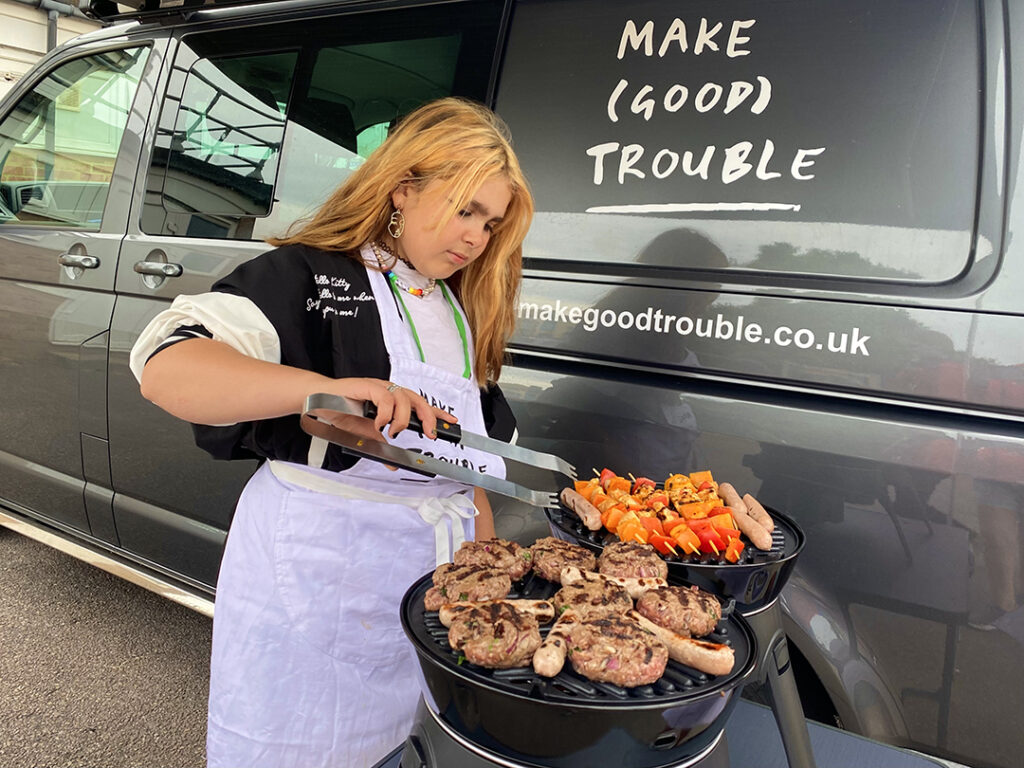
Thanks to our friends at Barclays Eagle Lab in Brighton, the van has our company logo and web address emblazoned on the sides and front, helping to publicise our work. The MGT van has enabled us to expand our detached media production work and helps us to offer opportunities to young people, wherever they are, to learn new skills and use equipment and technology they may not have had the chance to use elsewhere. This will help us to meet our aims of improving the outlook for children and young people living in areas of low income and deprivation, and reduce social isolation of at-risk children with more regular contact, enabling the building of friendships by safely widening their contact with other young people through structured workshops and activities,
The mobile unit will be operational year-round, without limitations of fixed time periods, venue hire and restricted access due to affordability (such as children’s travel costs to fixed venues).
Team training
In April, members of our team had training in Most Significant Change (MSC) methodology as part of the preparation for The Catalyst programme for ESCC (see below). It is a qualitative evaluation technique that fits with Make (Good) Trouble’s ethos of putting young peoples’ and families’ voices at the heart of any intervention and programme. We believe that MSC is a strong evaluation tool that can help inform the future direction and effectiveness of a programme based on direct learning from participants.
Make (Good) Trouble is accredited on the Badge Nation scheme, and we awarded over 100 Digital Badges to young people across the South East of England.
All the projects we have been involved with this year have helped to further our goal of improving wellbeing and outcomes for young people and families. They have helped us to highlight the issues that affect young people, and provided them with a platform to share their views and have a say in initiatives that would affect their future.
Raising Teens
Raising Teens Facebook Group
We continued to support parents and young people through our Facebook group. The group has become instrumental in helping us to reach families who need help.
Group membership rose to just under 2,000 from 41 different countries. The group had 1.4 posts a day on average (10 a week), with 73% from people in East Sussex.
Holiday Activities and Food programme (HAF) for East Sussex County Council
Easter and Summer Clubs
Make (Good) Trouble ran clubs and activities over Easter and Summer 2022, commissioned by East Sussex County Council (ESCC). We provided young people in East Sussex with a safe, enriching environment in which to play, learn and unwind. Our clubs, planned and run by young people, were free for children in receipt of benefits-related free school meals. Make (Good) Trouble is one of very few clubs that offers places to the older age-range that includes teenagers. We partnered with South Downs National Park to offer outdoor activities.
Our HAF clubs gave children the opportunity to make good memories, during one of the most uncertain times in recent history. Attendees learnt valuable transferable skills in media production, team building and hands-on learning helping to improve their confidence. Our club was featured on BBC South Today news with young participants interviewed about how the club was helping them during the cost of living crisis.
Feedback
“You’re trying something new and you’re not just sat at home watching TV because that’s what I’d usually be doing right now. It’s just a great way to make new friends. It’s just so amazing.” Attendee feedback
“My mum was saying would you go back, and I was like yeah definitely I was like I really want to go back.” Attendee feedback
“Yeah I’m happy to be here. I just wish it could last longer though to be honest.” Attendee feedback
“It’s wonderful for me to know he’s out, having fun and he’s safe. It’s such a weight off my shoulders. I love seeing him go off in the morning, looking forward to the day and then he comes home tired but smiling. For me that’s everything.” Parent feedback
HAF peer-led review and evaluation
Make (Good) Trouble carried out a peer-led review of East Sussex County Council’s Holiday Activity and Food programme. Our team visited 10 HAF Clubs across East Sussex over Easter, summer and winter 2022. Using our peer-led approach, our young producers recorded audio interviews with children aged between four and 16, as well as parents and carers, service providers and youth workers. The report, written for the council and the Department for Education, looked at how young people and families’ wellbeing was supported by the HAF programme; the effectiveness of club activities and nutrition; and how easy it is for families to access services. We also reviewed how providers were supported in setting up and administering clubs as well as whether budgets met needs, and what clubs might need for future provision.
We found that clubs are providing a lifeline for families and are going above and beyond to offer a broad spectrum of high-quality activities for young people.
“It just gives me somewhere to go to be with my friends. It’s all organised for us so we don’t have to worry about it. It’s all planned, and all my friends are here, it’s just really good fun.” HAF child participant interviewed by Make (Good) Trouble.
“The club is incredibly important to him. He goes to special needs school and has had a lot of bullying so doesn’t go out much or socialise with anyone from school or his own age, so for him to feel safe and know he can just be himself is massive. He trusts all the staff and looks forward to seeing everyone. It’s lovely for me to know he’s safe. He never comes home sad, always with a smile on his face.” HAF parent interviewed by Make (Good) Trouble
The Catalyst
In May 2022 we began work on The Catalyst, a two-year creative programme commissioned by East Sussex County Council (ESCC) Public Health as part of their ‘Creative Health. programme. The Catalyst’s aim is to build local young people’s personal and cultural wellbeing; develop creative and digital skills and insights into professional practice; reduce loneliness and isolation through the development of a creative network and thriving peer community; and evaluate the programme and contribute to the growing evidence base on the benefits of the arts to improve health and wellbeing.
The programme runs to autumn 2024 and invites young people to explore, create and debate in structured workshops across East Sussex where they can work with artists, photographers, film makers, and sound designers, and sign up for a mentor who will offer career and wellbeing support and advice. The programme is free and open to anyone aged 12 to 24 living in East Sussex.
Beach Walks
In May and June 2022, we hosted a series of accessible community-support beach walks in Brighton & Hove, for parents and carers of teenagers. After lockdown, many were reporting issues of isolation and feeling unable to cope. We got together for a walk, a coffee and a chat with professionals who are experts in teen-related issues which included eating disorders, LGBTQ+ issues, conflicts at home and more.
We hosted Facebook Live Q&A sessions which gave parents who couldn’t make the walks a wealth of practical tips and information on helping young people with everything from anxiety to sleep and tools to reduce anxiety and stress.
Most parents and carers who attended the walks had issues affecting their own mental health. The programme had four main beneficial outcomes: reducing social isolation, exercising, access to one-to-one expert support, and peer support. The selection of experts was driven by need, and included a Senior Assistant Head Teacher, a Safeguarding Lead, and representatives from Relate, RU OK, AllSorts and The Trust for Developing Communities (TDC).
One parent recently moved to Brighton to get her SEND child into a specialist school. This meant she was now living far away from the rest of her family, and as a result was suffering from isolation. The walks allowed her to get one-to-one help from experts and meet new local parents and carers on a regular basis.
One grandparent who attended all beach walks told us the programme allowed her to begin the process of addressing what she described as “Pandemic agoraphobia”. Being outside in small numbers allowed her to “ease back into the busy world”. She was also able to get trusted advice in relation to her grandchild who has issues with substance misuse and school avoidance.
A WhatsApp support group, managed by MGT, was created for every beach walk participant, providing a private, safe space for signposting services and to share support. Feedback from members was extremely positive. “The beach walk was instrumental in getting me to where I am now!” – Parent feedback via WhatsApp.
“I was going through a cycle of distress regarding my son’s education and lack of SENCO support and saw on the ‘Raising Teens’ Facebook Group you were offering Beach Walks and at the time I just needed to get out the house, I was exhausted, frustrated and felt alone. I needed to speak to people and stop driving myself mad on my own.
“The expert attending was a head teacher from a local secondary school which was brilliant. She gave me honesty that I hadn’t heard from any other teachers. That conversation allowed me to have the knowledge I needed to feel I could go back to his school and find solutions. Now he’s finally getting the support he needs.
“Before, I was in crisis mode, so my head was all over the place. This gave me a reason to get some exercise and fresh air. I loved being bought a coffee! It was so lovely to meet new people and feel valued.” (Parent, Beach Walk programme)
The Rez for the University of Sussex
MGT collaborated with the University of Sussex to produce workshops working with primary school pupils. These workshops were designed to research the impact of ‘The Rez’ podcast and comic, which were created to support the transition to secondary school and open up discussions around kindness and friendships. Three Comic Strip Workshops were delivered at Chesswood School, Worthing, Attenborough Centre, Leicester, and Stanford Middle School, Brighton.
Make (Good) Trouble was integral in delivering the design and development of new teaching guide and school lesson plans for Key Stage 2, which was awarded the PSHE Quality Mark for teaching resources in October 2022. Since achieving the Quality Mark, the guide has been shared with the PSHE Association’s national network of teachers and schools. The guides are designed to create a safe and engaging learning environment in which to teach about kindness and communication. More than 1,500 comics have also been distributed, with a second print run to meet demand.
Goal Power
Make (Good) Trouble was involved in a project to support a new exhibition at the Brighton Museum and Art Gallery in the summer of 2022. Goal Power! Women’s Football, 1894-2022 coincided with the UK hosting the UEFA Women’s EURO 2022. Brighton was one of the host cities with matches being played at the AMEX stadium in July.
As part of a programme of creative activities running at the Museum, Make (Good) Trouble worked alongside photographic artist and facilitator Lindsey Smith, to help seven young female players create a podcast about their love of football. We trained them in interview techniques and how to use audio equipment. The young players, aged between 12 and 14, interviewed each other, legends of the game, and those working in and playing football today. The resulting podcast series which explored the benefits of football for girls and some of the barriers they have faced, was included in Brighton Museum’s exhibition, on their website, and was featured on BBC Radio Sussex and Surrey. Titled ‘Goal Power’, the podcast series gives us real insights into what it was like to be a player in the 1960s and 1970s, and shows how the game is changing for women involved in it today.
Covid Vaccine take-up research project for BHCC
Public Health, Brighton and Hove Council (BHCC) asked us to carry out research to better understand why so many young people in the area hadn’t had a Covid vaccine. Make (Good) Trouble’s Young Story Collectors carried out individual interviews with ten young people aged between 16 and 18, and ten parents and carers who told us about the experiences of deciding whether to get the vaccine for their children, and what it was like for those who got the Coivid jab.
We set up relaxed one-to-one sessions for parents and young people to gather their views.
Our report used the stories from parents and young people to inform Public Health about the issues around why so many local young people were refusing or not bothering to get the vaccine. It covered their views, government messaging, the polarised debates on the issue, where they found information, as well as the practicalities of getting the vaccine in schools, walk-in centres or at GP surgeries.
Talks and business networks
In March 2022, MGT co-founder Daisy Cresswell featured on BBC Radio 4’s ‘Past Forward: A Century of Sound programme called Teen Age’, discussing the work Make (Good) Trouble do and her past experiences of being a teen, and of being a mum to teens today.
Make (Good) Trouble’s Lola Ray was invited to speak at The Power of Courage: Women in Leadership conference organised by Dorset Police. Lola talked about Make (Good) Trouble’s work and about her experiences on safety, trauma, and the police.
How we involve stakeholders in what we do
MGT’s stakeholders are the young people we work with and parents and guardians. The young people involved in every project we run are co-creators, and we hold discussions with them and their families to inform projects from inception to delivery. The projects are focused on improving their wellbeing and based on their needs.
Listening to our stakeholders is central to the work we do. At our HAF holiday clubs, we asked our young attendees to come up with the rules they would abide by at the club. The Beach Walks gave us a great opportunity to hear from parents and professionals to better understand their needs. Our Raising Teens Facebook group, which is managed solely by MGT now stands at just under 2,000 members, and we use it to reach parents and carers from the local community and further afield. It helps us to catch concerns early, such as school refusals, teen anxiety, and finances. These concerns and issues are fed into ideas for future projects, for example, series 5 of Raising Teens, due out early 2024.
Stakeholders are also youth workers, professionals, teachers and public health teams. We have been involved in consultations with Local Authorities (East Sussex, West Sussex and Brighton & Hove) on a regular basis as well as through our school and FE college networks. These consultations have resulted in new project development as well as support and advice for vulnerable communities and families in Brighton & Hove, East and West Sussex and beyond.