
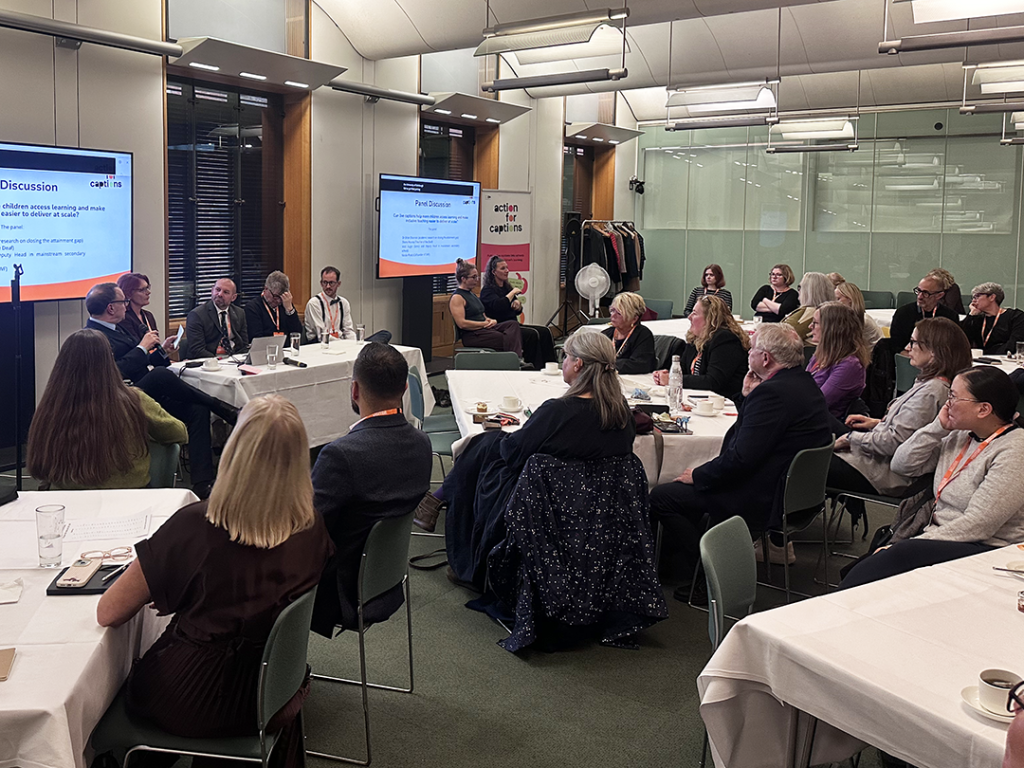
If live captions are cheap, easy to use and effective, why isn’t every school using them? That was the question posed to a room of teachers, researchers and campaigners at the House of Commons on 20 October, at the Live Captions in Education Summit. It was hosted by the brilliant Sound Waves Foundation, a charity celebrating deaf identity and working for equality through innovation, creativity and technology.
Why live captions matter for deaf children
For deaf children, following a lesson takes constant effort. Even with hearing technology and lip reading, they are listening, watching and processing language while also trying to learn something new, and it’s easy to fall behind. Live captions put the teacher’s words on screen as they’re spoken, giving children a second route into the lesson. They can check what they’ve heard and catch what they’ve missed, spending less energy working out what was said and more on the learning itself. That builds the confidence to join in and take a full part in class alongside their friends. Our work on the project showed us what that means day to day. Children found it easier to feel part of the classroom community and relied less on their teaching assistant, which gave them more agency. They also felt less of the embarrassment of constantly putting a hand up to ask for explanations.
We came to the summit with more than a passing interest, because we’d heard these stories first-hand. Make (Good) Trouble has been part of Sound Waves’ Action for Captions project, using the Most Significant Change approach to hear directly from the teachers and children using live captions in their classrooms. We left more convinced than ever that this work deserves far more recognition, and we want to help make that noise.
A playing field that is far from level
Most Significant Change asks people to tell the story of what has mattered most to them, rather than ticking boxes. Our conversations with children and teachers showed us how valuable captions are in levelling the playing field, for all children and not only those they were first set up for.
They also opened our eyes to how un-level that field is today, despite the efforts of some brilliant teachers.
The pupils we spoke to at Manor Primary made that plain. One said that without captions they could only catch the gist of a lesson; with them, lessons became something to attend to and put effort into. Another put it simply: “I can see what the person is saying because I don’t hear very well.” A pupil with dyslexia and working memory difficulties could now instantly check anything misheard. Their teacher saw all of this without any extra workload.
Shane Murray, a profoundly deaf Teacher of the Deaf at Manor Primary in East Sussex, explained why the problem stays so hidden: “When you miss something, you don’t always know what you’ve missed.” A pupil can look at the teacher, even answer a question correctly, and still have lost part of the lesson.
Saul Regan of Brighton & Hove’s Inclusion Support Service showed the human cost. He told us about a young man with a rare degenerative illness who spent his whole education in a separate room with a teaching assistant, because live subtitles were either unaffordable or too inaccurate to use. He never learned alongside his classmates, and missed out on the friendships that come with it. That support can now be switched on for free.
The numbers behind the stories
The need is huge. Sound Waves’ figures show that 78% of deaf children attend mainstream schools, and 18% of schoolchildren (1.7 million) have identified special educational needs. Saul added that around one in 10 children are believed to have auditory processing disorder, and live captions can help them too.
The evidence shared at the summit was just as striking:
- Two years of progress. Shane assessed two deaf pupils’ vocabulary and reading comprehension before captions were introduced, then tracked them for two years. Both progressed faster than historical data would have led him to expect. He is careful not to credit captions alone, but the signs are encouraging.
- 500 children in about a year. Brighton & Hove only began its rollout in September 2025. Roughly 500 children now use live captions, and the number is growing.
- 40 years of research. Dr Robert Vanderplank of the University of Oxford has studied captions and language learning since the 1980s. He showed that seeing and hearing words together eases cognitive overload and anxiety, and he was struck by how closely the stories we gathered at Manor Primary matched his findings.
- 30 seconds and £14. Matt Auger, a deputy head and SENCO at a mainstream secondary school, says captions are free in Windows 11 and take about 30 seconds to start. His school’s only cost is a £14 webcam, used for its microphone. Training his last colleague took under five minutes.
- 54% of us already use them. Stagetext’s research found 54% of people use subtitles when watching TV, and most everyday users are under 25. For this generation, words on a screen are simply normal.
Teachers at the summit kept coming back to the same point: captions introduced for one deaf child also helped pupils with dyslexia, ADHD, processing difficulties and English as an additional language. As Helen Hayes MP, chair of the Education Select Committee, told the room, when we get the environment right for children with additional needs, everybody benefits.
So why isn’t it everywhere?
The barriers are mostly human. Schools are swamped with new initiatives, teachers worry about what might appear on screen, and teachers who start using captions can forget to switch them back on after a half-term break. A noisy classroom can also reduce accuracy, whatever software is used. Dr Vanderplank warned of pushback ahead, often starting with funding, even though the software is free.
What decides it, speakers agreed, is a champion. Where a head, deputy or SENCO backs captions, they stick. Where nobody does, they stall.
The timing could hardly be better. The government’s SEND reforms aim to make every classroom inclusive, and local authorities are now defining their “ordinarily available provision”, the baseline every child can expect. Saul has already written captions into section after section of Brighton and Hove’s version. As Shane put it, inclusion is about whether a student can access what’s happening in the classroom, not just about having them in it.
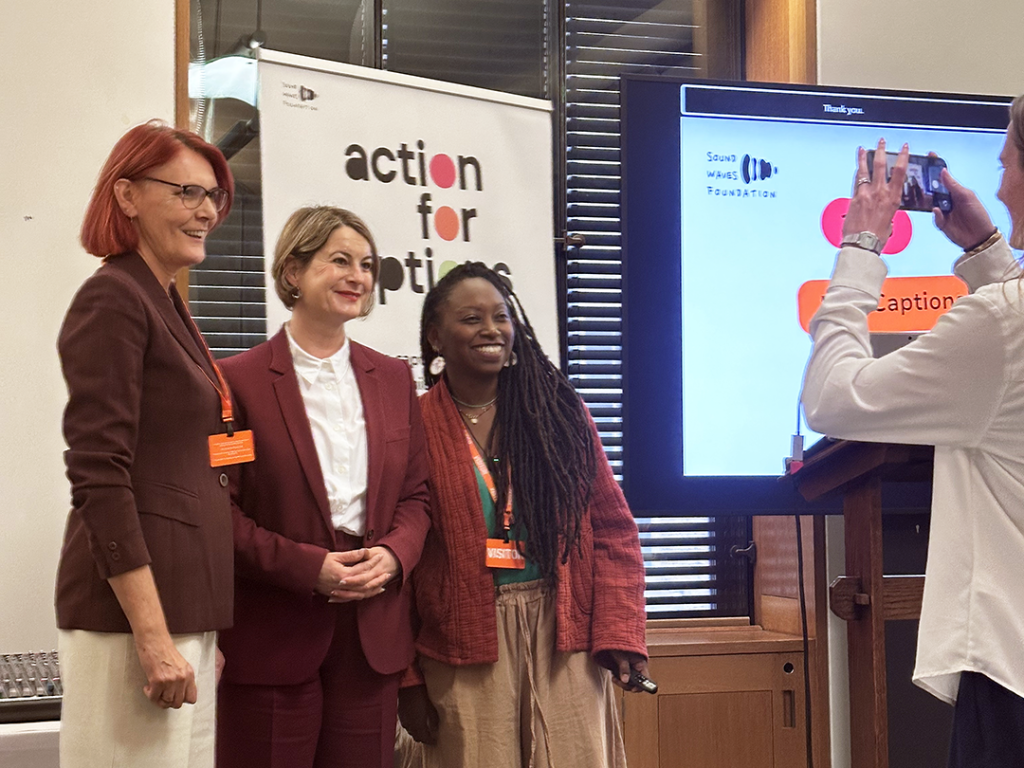
Thank you, Nicola and Silvie
None of this would be happening without Nicola and Silvie, the two mums who founded Sound Waves Foundation after watching their deaf children struggle with online learning during lockdown. They have taken a grassroots idea all the way to Parliament, led throughout by what children tell them. Their closing message on the day was that they are not going to give up. And neither are we.
What happens next
Make (Good) Trouble will keep sharing what children and teachers told us. Media training for young people is at the heart of what we do, so we’d love to help them make this case in their own voices. Saul told us of a primary school where it’s the other children reminding teachers to turn captions on. That’s a groundswell worth building on.
Here’s how you can help:
- Students: if your school, college or university doesn’t use live captions, ask for them. Your voice can make it happen.
- Teachers: try it tomorrow, then swap tips on the Sound Waves forum.
- Heads and SENCOs: be the champion your school needs.
- Local authorities: write live captions into your ordinarily available provision.
- Policymakers: the Department for Education wasn’t in the room this time. We’d love to see it there next time, and to see captions named in guidance on inclusive classrooms.
One student on the Sound Waves website says it best: “I want to keep live captioning in future – definitely, definitely, definitely.” So do we.
FAQs
What are live captions?
Live captions turn speech into text on a screen as it’s spoken. In a classroom, that usually means the teacher’s words appearing on the interactive whiteboard, or on a pupil’s own laptop if they prefer. They help deaf children first and foremost, and also many pupils with dyslexia, ADHD or language processing needs, and those learning English as an additional language.
How easy are they to use?
Very. Live captions are built into Windows 11 for free, and they take about 30 seconds to start. Most schools only need a cheap microphone. Teachers can change the text size and colour, and switch on a profanity filter. Sound Waves has free guides and a forum to help schools get started.
Who are Sound Waves Foundation?
Sound Waves Foundation is a charity (no. 1197686) celebrating deaf identity and progressing equality through innovation, creativity and technology. Nicola and Silvie, both mums of deaf children, founded it after seeing how inaccessible home learning was during lockdown. As well as Action for Captions, its projects include the SignRise online British Sign Language platform (the first lesson’s free – give it a go!) and Deaf Kids Tip Kits.
What is Most Significant Change?
Most Significant Change is a story-based way of evaluating a project. Instead of measuring against fixed targets, it asks the people involved what has changed for them, which change matters most, and why. That puts their own words and priorities at the centre, which is why it worked so well for hearing from children and teachers about live captions.
What is ordinarily available provision?
Ordinarily available provision is the everyday support and adaptive teaching that mainstream schools in England are expected to offer from their own resources, without a child needing an education, health and care plan (EHCP). Local authorities set out what it looks like in their area, and it sits at the heart of the government’s proposed SEND reforms. Getting live captions included would make them part of everyday support, rather than a special request.