I have just read Molly Ringwald’s article in The New Yorker where she revisits the John Hughes teen flick through the #MeToo lens. The Brighton5 (adult) team had already started commenting on it on our WhatsApp group – comments like “it’s great to think about the content (for BTN5) in terms of legacy and how it might be interpreted in years to come.” It got me thinking about John Hughes’ ability to write content that so accurately reflects what it’s like being a teenager, and how hard it is to write scripted content and get it spot on.

The Brighton5 project is unconventional in so many ways – in meetings I often describe it as being just like teenager: it doesn’t work in straight lines (development), it has suddenly grown and bolted off down the road and I am constantly trying to catch it up! One thing I am learning as we go through the development phase is the power of listening. Our Brighton5 teenagers NEED to be heard. At the moment, Brighton5 seems to be writing itself, with careful guidance and positive spirit.

So, what about ‘The Breakfast Club’? My teenage girls LOVE that film. If I put it on the TV they are guaranteed to join me on the couch (a rare thing!). I asked my eldest teen why she loves it? “It’s relatable, Mum, it’s about kids accomplishing things without adults. At the end of the day, it’s a feel-good film.”

So there you have it. Three goals for Brighton5. Sorted. So far the development has been the most exciting and terrifying experience of my working life. But who said any of this would be easy? One thing is for certain, we will listen, so they can make.
Something amazing happened in Washington DC on Saturday. After just 5 weeks of organising, Parkland students led a march of over 850,000 people calling for a change in gun laws after 17 of their fellow students and teachers had been shot and killed on campus.

They raised $3.5m from 42,000 people through a GoFundMe campaign for the march, and another $2m was given by celebrities. They used the press interest around the shooting to speak out and call for change. They’re also targeting the November elections to support those calling for gun law reform and vote out those who don’t.

It’s time – long overdue – that we give our teens a voice. A vote. A say in their futures.

The students eloquently summed up Saturday’s march in The Guardian:

“We Parkland students have a platform never seen before. We plan to utilize this voice, because it is our own, and because it is our right. We will use it to advocate for legislation that will not only stop the mass shootings, but also the gun violence in cities like Baltimore, Chicago, and DC.

The movement to end gun violence has been active for a long time, and there’s always a breaking point – a moment which changes everything. I hope Saturday will prove to be one of those moments. I believe it can be it. This is just the beginning of the galvanization of a movement that will transform the culture of America, hopefully into a nation where gun violence is not normal, and not OK.

On Monday, I will be back in Parkland. I will continue to go to class and sports games, continue to write for my paper. But I will also continue to fight, and so will others.

We are articulate. We have opinions. We demand change. And we are not going anywhere.” 

Rebecca Schneid, the co-editor in chief of the Eagle Eye, Marjory Stoneman Douglas High School’s newspaper in Parkland, Florida, writing in The Guardian.

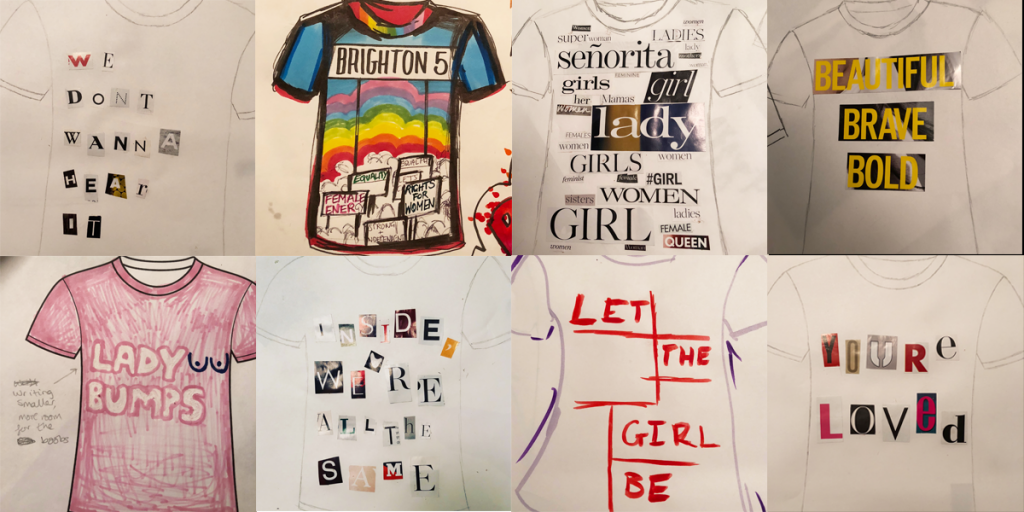
Brighton5 T-shirt designsOn 8 March we celebrated International Women’s Day – which marks one year since the idea for Brighton5 came about! – by inviting our teens to create slogans and T-shirt designs for our project.
It was an amazing and productive evening with T-shirts that we all want to wear! A huge thank you to our teens.

The best bit? The lovely Emma Knight sporting one of our teens’ designs (ace work Chloe!). Emma requested the Lady Bumps T as she’s going through treatment for breast cancer, so we printed one up for her. Big love to you Emma. ❤

Everyday I find stories that involve teenagers, device addiction and mental health. They are all over the press, as rates of depression and self-harm soar in youngsters.

One article that caught my eye, by Tech journalist Moya Sarner was about Belinda Parmar – who “was a passionate advocate of the digital revolution – but has started keeping her family’s smartphones and laptops locked away to protect her loved ones”

I then had a very interesting discussion with my 17 year old daughter about confiscating devices. She said “if the kid is trusted with the device it shouldn’t be confiscated.” And there lies the problem. It is not necessarily our kids we don’t trust but the social media giants who have deliberately created addictive platforms and the unregulated content that is published on them. Try explaining that to my 13 year old. Do I trust her to discern which content is suitable for her? I am afraid not.

To quote the article – “These experts agree that abstinence is not the way forward: instead, we need to build what they call digital resilience, and learn to use technology in a measured, controlled way.”

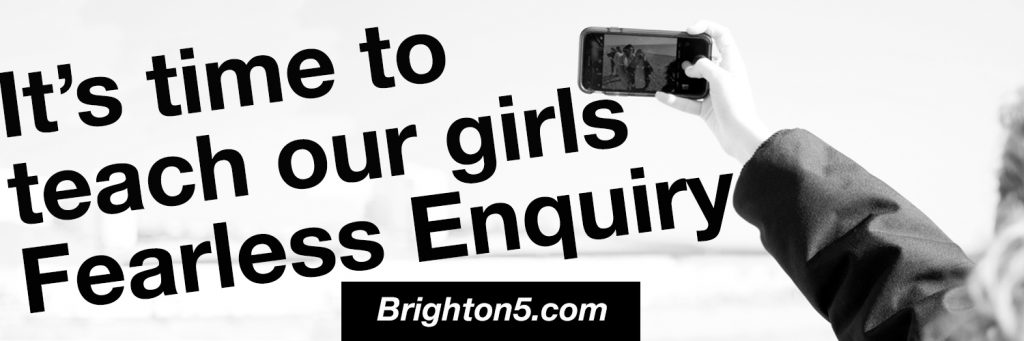
One of the five core pillars of Brighton5 is to teach our kids fearless enquiry. To teach them how to discern, to question, and to ultimately understand the ramifications of their digital activities. This should be done in ways they can relate to – younger teens are heavily influenced by older teens, so Brighton5 aims to empower teens to change their behavior for the better, by helping them help themselves.