How do parents cope when their teens kick off? Anger is a powerful emotion and the teenage years can see an explosion of strong feelings.

Raising Teens is back for a second series on Monday 4 November 2019. Episode one covers anger in teenagers. Our young reporter, Lola, interviewed teens to discover how they feel when the red mist descends.

“I just kind of feel explosive and just like I want everyone to shut up and listen and just… I dunno… I just feel really frustrated.”

“I can feel it tingling… like bubbling in my stomach. And it’s like, oh, not a nice feeling but it’s nice to get it out.”

Raising Teens host Guy Lloyd discusses why teens get angry, and what parents can do when it all kicks off, with four guests: Donna Peters-Lamb, psychotherapist at Make Sense Psychotherapy, PC Joe Davies, from Sussex Police Youth Prevention Team, Carl Scott, Reboot (early youth intervention programme) coach, and Ed Hallwood, Room to Rant tutor from Audio Active.

Join us at 8pm on Monday 4 November on BBC Sussex and BBC Surrey and online.

If you need help with teenage anger, here are some great resources:

NHS advice on teen aggression and arguments 

Young Minds’ advice for teens on anger 

Young Minds’ advice for parents on anger

Young Minds’ Parents Helpline: 0808 802 5544 (Monday to Friday 9.30am – 4pm, free for mobiles and landlines) 

Audio Active’s Room to Rant: A space for young men to be themselves, talking and exploring their struggles and life experiences through spoken word, rap and hip hop.

Make Sense Psychotherapy: Donna Peters-Lamb’s private practice in the Brighton and Hove and East Sussex area
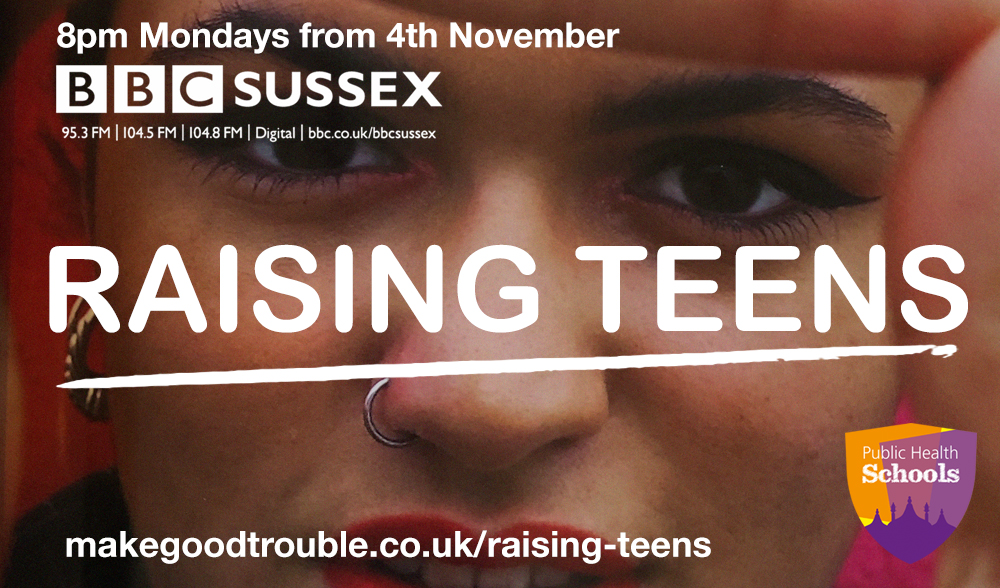
We think every day should be World Mental Health Day. Because more needs to be done to help those who need it. We’re working with teens to highlight their wellbeing and to give them a voice. We’re also giving parents support in our brand new series of Raising Teens, starting on Monday 4 November on BBC Sussex and BBC Surrey. This series we’re looking at teen anger, alcohol, grief, self-harm, family breakdowns, eating disorders, loneliness and the teenage brain. Each episode includes the voices of teens, interviewed by our teen reporter Lola, and advice from parents and experts. 

Raising Teens radio show promotional image

On World Mental Health Day, we’re calling for more should be invested in our young people – from a better education system – one that feeds our children’s minds and creativity and doesn’t exclude those who don’t fit – youth clubs and out of school support, all of which has seen a huge cut in funding over the past decade. The number of teenage suicides has risen 67% between 2010 and 2017 in England and Wales according to the Office for National Statistics. We think there should also be more support for parents and carers, teachers and health workers dealing with the rise in young people with mental health issues.

You can catch up on all of series 1 of Raising Teens which covers social media, school stress, sleep, resilience, body image, relationships, the teen brain and teen language. 

Plus, here are a ton of really useful links that we’ve collected along the way from all the amazing experts we spoke to.  If we’ve missed any really good organisations from our list, let us know in the comments below. Thank you!

We’ve just signed up to Natasha Devon’s brilliant initiative, the Mental Health Media Charter. Launched in 2017, it is a set of seven guidelines for reporting and talking about mental health in the media and online.

Mental Health Media Charter badge

You can read the guidelines in full here – they’re not just good standards for the media, but for anyone talking about mental health.

Signing up to the charter means that we will do our best to talk responsibly about mental health – for example recognising the difference between mental health (which we all have) and mental ill health.

If you haven’t come across Natasha Devon before, she’s a campaigner for better awareness of issues around mental health, body image and gender and social inequality. Her book: A Beginner’s Guide to Being Mental is a great read and full of insights and tips on everything “from Anxiety to Zero f***s given”.

We’re delighted to announce that Natasha will be a guest on our upcoming series of Raising Teens, due to air on BBC Sussex and BBC Surrey this autumn.

⭐️ Find out more about the Mental Health Media Charter

⭐️ Find out more about Natasha Devon

⭐️ Listen to series 1 of Raising Teens

Make (Good) Trouble’s mission is to help break down the barriers between teens and adults, to put paid to the myth that teenagers are just sullen, snowflakey beings that need to “grow up”, “pipe down” or “behave”.

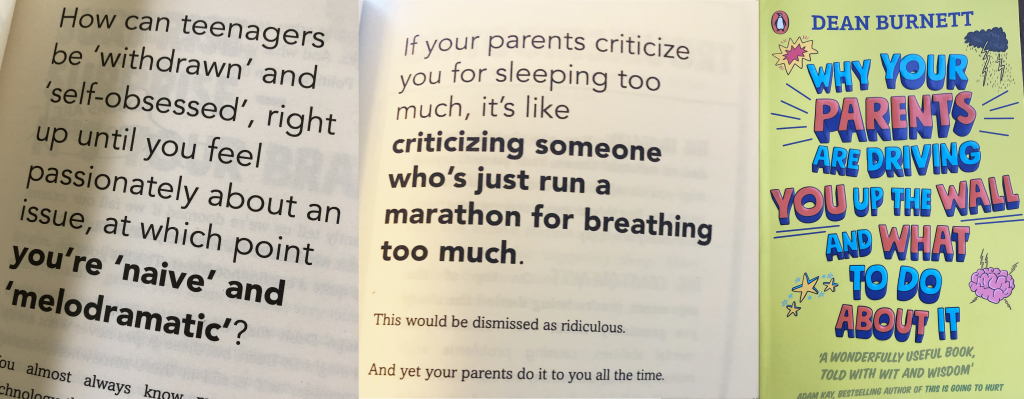
A brand new book – out today – really chimes with our purpose. ‘Why Your Parents Are Driving You Up the Wall and What To Do About It’ is a brand new book written for teenagers by neuroscientist Dean Burnett. The book describes in glorious detail how the changes in the teenage brain fundamentally affect the relationship teens have with their parents. It looks into how parents’ fixed brains are befuddled by their teen’s seemingly risky, volatile, unthinking behaviour. It includes fantastic troubleshooting guides for teens to help with their parents’ inflexible demands – bringing understanding – and hopefully some sense of calm – on both sides. Want to know why your parents think “you treat this house like a hotel?” Dean Burnett explains. And yes, it’s the parents’ fault. 

“The truth is, you have always treated the house like a hotel, by assuming your parents will take care of all the housework. Because for your whole life thus far, they did!”

Dan Burnett: Why Your Parents Are Driving You Up the Wall and What to Do About It

It’s intelligently written – which is what you’d expect from a neuroscientist! – but as it’s aimed at teens (who start at 10 years old by the way). It’s refreshingly frank, warm, honest and funny and really does relate to all the realities of the parent-teen relationship. 

The book is particularly fascinating when it comes to descriptions of the brain and how it works, giving us a real insight into the teenage brain and how it impacts on everything from sleep, social media and school to family and mental health. 

Read this book if you’re a teenager. If you know a teen, do them a favour and buy them a copy.