
“I’ve just listened to the Raising Teens Neurodiversity podcast and it’s absolutely fantastic. I’m really enjoying listening to the advice from the panel as well as other young people’s own thoughts and feelings that are similar to my own. I also listened to the Trauma podcast and I’m in tears hearing what the panel had to say about my own story and just hearing it back. I can’t put into words how brilliant this show is and I hope more people can hear it because it could be life-saving for someone going through something similar!”
This lovely quote is from one of the young people who shared their story with us for our BBC podcast, Raising Teens, which was broadcast in January and February. We hope you’ve enjoyed the series. In our last newsletter, we promised to send you links to our final two episodes, and here they are:
Raising Teens: Neurodiversity
Whilst neurodiversity isn’t a mental health condition, many children and young people experience challenges with their mental health. This episode of Raising Teens brings experts together to look at the experiences of neurodivergent young people and how families can support their children so they can develop and thrive. We also look at what role getting a diagnosis plays in that. We hear from young people about the social pressures they face to behave ‘appropriately’ – or like their neurotypical peers – at school, in friendship groups, and communities and how coping strategies can take a huge toll on their emotional wellbeing.
🎧 Listen to Raising Teens: Neurodiversity on BBC Sounds
👋 More information about this episode and links to support
Raising Teens: Support in Schools
In our final episode of series five, we look at what mental health support is available in schools. Long-term, children and young people who struggle with their mental health are more likely to have poorer physical health and economic outcomes than their peers. So we discuss how schools can help to improve the outlook for our young people, what help they’re entitled to, and whether schools are equipped to provide that support and help prevent the need for clinical treatment. It’s not known how many children are educated at home, but in a recent report from Schools Week, they estimate that there has been a rise of 60% since the pandemic. What support can home-schooled young people expect?
🎧 Listen to Raising Teens: Support in Schools on BBC Sounds
👋 More information about this episode and links to support
🎧 Catch up on all episodes from Series 5.
🎧 Plus you can catch up with previous series of Raising Teens – covering everything from social media and loneliness to county lines and the teenage brain…
Make (Good) Training!
We’re rolling out new training sessions for young people to help with their self-confidence and communication skills. Interview Skills and Techniques will help young people to walk into a room and feel empowered to have a meaningful conversation with anyone. These workshops are driven by a desire to help build social skills in young people after a marked decline in recent years. 42% of parents of 12-15 year-olds reported a decline in their child’s social and emotional development, with 4-7 year-olds faring even worse at 52%, according to a report by the Institute for Fiscal Studies. Social skills are seen as increasingly important in a future driven by automation in the workplace. We want to help young people get ahead of the curve.
If your organisation is interested in finding out more about our Interview Skills Training workshops, get in touch!
Drama workshops this Easter
We’re running drama workshops this Easter in collaboration with the brilliant team at Dragon Drama. It’s all part of East Sussex’s Holiday Activities and Food programme and places are free to children in receipt of free school meals. Registration opens on Monday 11 March, and you’ll be able to sign up for the club via this link next Monday.
Work with us!
If you’re interested in working with us – collaborate on new or current initiatives, partner with us, fund or donate to our programmes, we have a band new webpage with all the details: Work With Us!
👋 Do share this blog with anyone you think might find it useful. Thanks!
We hope you enjoy Make (Good) News. If you have any suggestions or news you think we should cover next month, send us a line!
The Make (Good) Trouble team x
news
Make (Good) News: January round up
onHappy 2024!
This round up is all about our brand new podcast series of Raising Teens which is currently being broadcast on BBC Radio Sussex and Surrey every Friday at 7pm – with a handy catch up on BBC Sounds. We’re super proud of this series which brings together amazing interviews with young people by our young reporter Lola Ray, brilliant expert guests and really important subjects in teen mental health.
Each episode brings you first-hand accounts from young people, and a panel of experts in the studio talking with new Raising Teens host Clare Cowan. They discuss the issues and how best to provide help and support. Each episode is full of fascinating conversation and great practical tips and advice. The series is supported by NHS Sussex.
Here’s a round up of the episodes so far, so you can dive straight into what interests you most. Each summary includes a link to listen as well as to sources of support and advice. We’d love to hear what you think of the series – you can leave a comment on our social media accounts or simply reply to this email.
Episode 1: Getting mental health support
This episode explores how parents & carers can navigate the system to find the right services and resources for their child. We know that many teenagers are struggling to access mental health support with average waiting lists rising in the last two years and over half of those on a waiting list reporting that their mental health had deteriorated (Young Minds). The pandemic and cost of living crisis have had an impact on what was already a growing crisis. We also talk to young people with neurodivergent conditions like ADHD and autism who’ve faced long waits to get a diagnosis, let alone help.
🎧 Listen to Raising Teens: Getting mental health support on BBC Sounds
👋 More information and links to support about getting mental health support
Episode 2: Supporting Adolescent trauma
When a child experiences trauma in their early years it can result in behaviours which can cause distress – to the child, their families and communities. They can include self-harm, risk-taking and being vulnerable to criminal exploitation. This episode explores how we can intervene early to help prevent family breakdowns and escalation, and how parents, the wider family, and friends can provide support.
🎧 Listen on BBC Sounds – Raising Teens: Supporting adolescent trauma
👋 More information and links to support for adolescent trauma
Episode 3: Treating eating disorders
In this episode, we explore eating disorders and how parents and carers can understand what’s happening to their teens and find the right support. We look at what‘s behind the sharp rise in the number of young people receiving treatment for eating disorders – a rise of almost two-thirds since before the pandemic. We talk about how services can keep up with the need for treatment and what we should we be doing as a society to help our young people who may be struggling.
🎧 Listen to Raising Teens: Treating eating disorders on BBC Sounds
👋 More information and links to support for treating eating disorders
Episode 4: Becoming an adult
The journey from teen to adult can be complex and hard to navigate without support and guidance. The teenage brain, changes in hormones, and upheavals in a young person’s personal life can be overwhelming, confusing and challenging. Almost half of teens have lowered expectations for their future because of the rising cost of living, according to the latest Prince’s Trust Youth Index. In this episode, we look into how we can support young people to make positive decisions about their future and best prepare to navigate the challenges of life.
🎧 Listen to Raising Teens: Becoming an adult on BBC Sounds
👋 More information and links to support for young people around becoming an adult
🎙️ Still to come on Raising Teens!
We have episodes on Neurodiversity – this Friday! – and Support in schools. We’ll cover those in next month’s newsletter.
🎧 Plus you can catch up with previous series of Raising Teens – covering everything from social media and loneliness to county lines and the teenage brain…
👋 Do share this blog with anyone you think might find it useful. Thanks!
We hope you enjoy Make (Good) News. If you have any suggestions or news you think we should cover next month, send us a line!
The Make (Good) Trouble team x
Make (Good) News: November round up
onHello! We celebrated 5 years of Make (Good) Trouble with a party – thanks to everyone who joined us! For those who don’t know our story, we began as Brighton5, aiming to reduce mental ill health in young people. Whilst that aim hasn’t changed, we’ve grown hugely in the last five years.
Au revoir Lola Ray!
We also said a fond farewell to Lola Ray who’s off on her travels for a year or so. She spoke to us before she left about her time at Make (Good) Trouble and what she’s learnt along the way. It was a lovely discussion.
👉 Read the interview with Lola here.
In the news:
Schools face rise in violence and behaviour issues
There’s been a marked increase in violence and behaviour issues reported in schools, with more young people staying home from school, or just not attending lessons. The Guardian reported that, “Unmet special needs, mental health issues and persistent post-pandemic absence are all creating tensions in schools, which can result in breaches of the behaviour code.” (The Guardian: Headteachers in England tell of worsening behaviour of pupils – and parents.)
We believe that more investment and support should be given to cash-strapped schools with a bigger focus on student wellbeing rather than on exam results. The Sutton Trust reports that underinvestment has resulted in low morale among teachers, cuts to teaching staff, and (perhaps unsurprisingly) difficulty recruiting new staff.
👋 If you need help, take a look at our Help page on Education, exams and school refusal. One great resource is Not Fine in School, which is an organisation set up by parents of children who have experienced school attendance barriers.
📚 If you’re interested in delving deeper into this subject, there’s a fascinating and sobering report by Public First that looks into the reasons behind today’s “attendance crisis”.
Public First: Listening to, and learning from, parents in the attendance crisis.
One in five children and young people had a probable mental health disorder in 2023
New NHS data “found that 20.3% of eight to 16-year-olds had a probable mental disorder in 2023. Among 17 to 19-year-olds, the proportion was 23.3%, while in 20 to 25-year-olds it was 21.7%.” And while these numbers haven’t risen in the past year, they haven’t decreased either, and these figures are clearly far too high. Read the NHS Digital report.
👋 We have plenty of resources to help young people with mental health issues. Our BBC radio series Raising Teens has a wealth of advice and insights. You can find links to all episodes here – they cover everything from anxiety, loneliness and self-harm to cannabis, county lines, and understanding the teenage brain. We have a brand new series coming out in January, so watch this space for news!
💌 Did you know that you can get our round up straight to your inbox every month? Just subscribe here and we’ll do the rest!
MGT News!
There’s still time to sign up for our Winter Holiday Club!
🎭 There are still free places at our 3-day drama Holiday Club this December run by the amazing people at Dragon Drama. Find out more here 👉 Winter Woodland Drama Workshop.
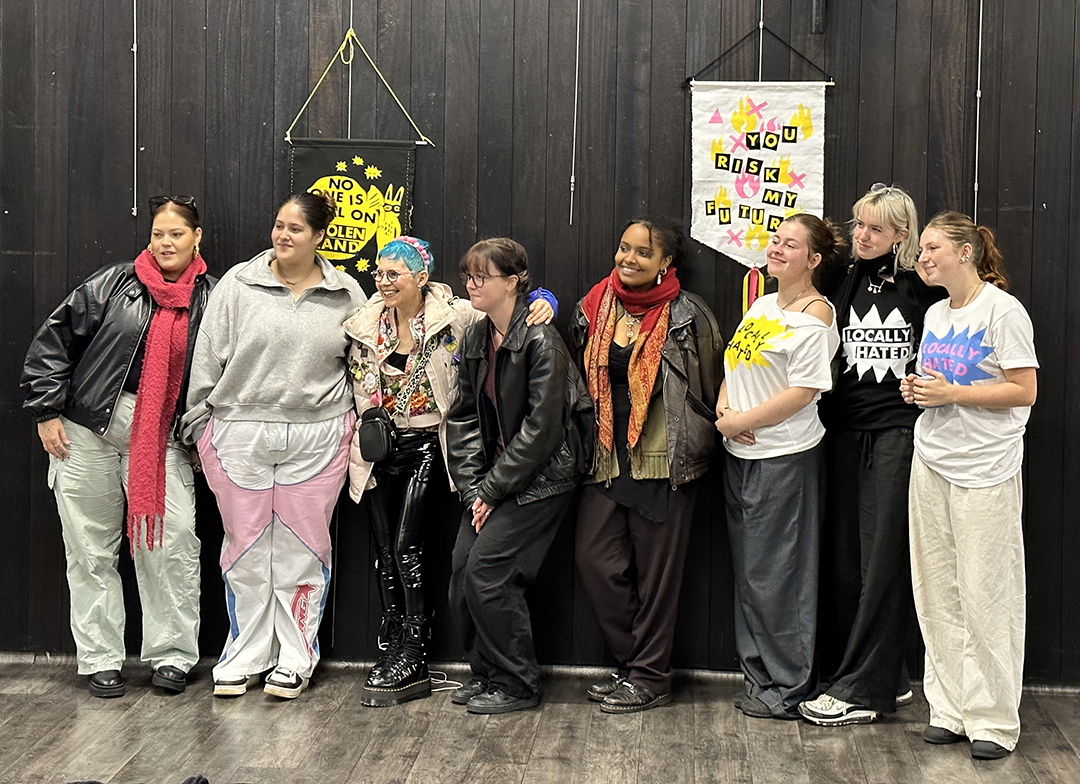
The Catalyst protest banners
Our latest Catalyst workshop with artist Kerry Lemon (below) was a great success with some amazing protest banners created. We’ll be running new creative workshops in the new year as part of The Catalyst programme.
Happy 40th birthday Hangleton & Knoll Project!
Make (Good) Trouble was commissioned to make a film to celebrate 40 years of the Hangleton & Knoll Project. If you don’t know about this amazing community in Brighton, take a look at the film!
That’s all for this issue. If you have any suggestions or news you think we should include in next month’s round up, please comment below or get in touch.
💌 Did you know that you can get our round up straight to your inbox every month? Just subscribe here and we’ll do the rest!
Au Revoir Lola Ray!
onLola Ray has worked at Make (Good) Trouble for the past five years – since she was 17 – first as a volunteer, and in the last few years as a young reporter and producer. This week we’re saying au revoir to her as she jets off on her travels for the next year or so.
Before she went, we sat down for a chat about her time with us, and her hopes for the future.
Can you describe what it was like when you first started working with Make (Good) Trouble – what was your first day like?
It’s been five years since I started working at Make (Good) Trouble (MGT). It’s been two years since I’ve been working on a daily basis. I remember the first day. We were in [MGT co-founder] Daisy’s kitchen, and I didn’t really know anyone apart from Lotti [who is now a Project Manager at MGT], and we had such a fun day. I can’t even remember what we did, but I just remember going home to my mum and I was really buzzing and I said, I’ve just had the most amazing day ever! It’s so cool and we’re doing this and they’ve got all these cool gadgets and stuff. And I was like, oh this feels really right. I knew it wasn’t going to be a job at the time but then whenever there was something happening, I was like, I’m there. I’m doing it. I’m going to be a part of that because it just felt like, first, a thing that was giving back and it felt really good to do that. But also, it was done in such a nice friendly way and it didn’t really feel like work.
And then when I started working properly, it was back at Daisy’s house with Lotti, making a film about the Holiday Activity and Food programme for East Sussex County Council. And then we moved to the office and that was like another first day. I feel like I’ve had quite a few first days with MGT because there have been so many iterations of it. It’s been great.
What is the best part of your job?
I think it’s the people. I think us as a team has been amazing. And I think our BBC Raising Teens radio show has to be one of my favourite projects. I mean, there aren’t any negatives to that project at all. I feel like it has some of the biggest outreach as well for us. One of the most powerful interviews I did was for Series 2, with a group of teens and they spoke to me about loneliness, depression and grief. It was really moving.
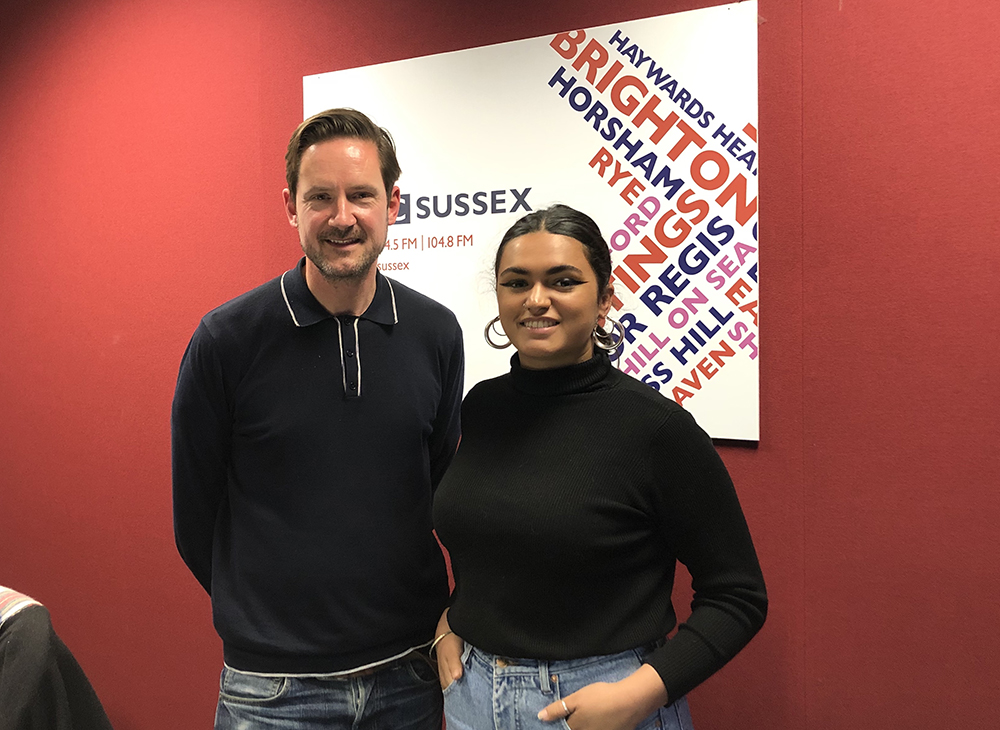
Lola with Raising Teens presenter, Guy Lloyd at BBC Radio Sussex
How do you feel you’ve grown within the company?
So much! Because when I started working with MGT properly, I hadn’t really done much, to be honest. I’d had a couple of jobs, I’d done lots of tele-sales work, but I’ve literally learned everything I know from you guys – from how to do a spreadsheet to what all the acronyms in this industry are! I really feel like I’ve learned about people and the relationships that you have with different organisations or working directly with young people.

I feel like I’ve been able to do a bit of everything, which is really nice, and it’s definitely what I needed to help me to know what I wanted and what I enjoy doing, to be able to have a go at everything to see what works for me, and also getting knowledge in all those areas. I don’t think many people get to do stuff like that. Here, every day is different.
What next for Lola Ray?
I’ve learnt so much being here for the last two years, but I had delayed my travel plans because of Covid – and I just happened to fall into Make (Good) Trouble after that, which has been amazing – but it’s time for me to go and just not live in Brighton anymore and do something else.
In the future, I don’t know if I’ll go more into production or into mental health. We’ll have to wait and see. I might have high expectations of everyone else compared to MGT!
And I’m not leaving, I’m just changing direction. It’s been so special to be part of this. And that it is something that has completely changed my life. And I don’t think I would be where I am today without it because I’ve learned so much. It’s so enriching, and the next person to come and work here is going to be very lucky to be a part of a team.
All we’ve accomplished, from starting in Daisy’s kitchen, not really knowing any of you, to five years later, it’s started me off in life, really. And I think if I’d worked anywhere else, I wouldn’t have been so enriched as I’ve been with Make (Good) Trouble.
Lola has been invited to join our Advisory Group, so she’ll continue to help shape the direction of Make (Good) Trouble in the years to come. Thank you, Lola! You’ve been amazing. Enjoy your travels x