Journalist Jan Edwards describes how an ordinary day of door-to-door fundraising led to his involvement with Make (Good) Trouble.
It was early January, and winter had firmly clasped its unrelenting, icy grip on Brighton and Hove, suffocating the distant memories of summer.
Shivering, my resolve to fundraise for homeless young people spurred me on. I started a new road, willing an answer for some warmth. I knocked, but there was no response. Maybe the next… “Hello! Sorry, I was cooking.” I rushed back. “Hi, I’m from Centrepoint.” “Ah, I know all about you!” says the woman, smiling. “Come in.”
While door-to-door fundraising can be discouraging, I relished meeting all sorts of strange, eccentric, but often wonderful people. At Centrepoint, I was yelled at, sworn at and chased down a garden path with a broom (only to be invited in for tea and an art lesson by the less cranky next-door-neighbour!).
Naturally, I was intrigued by this friendly woman who had provided respite from winter’s wrath. “You don’t need to say anything. I’ll sign up,” she said. I was bemused as even the most willing of donors usually take some persuasion. “I work for a social enterprise called Make (Good) Trouble, helping teenagers. I’m Daisy, the co-founder.”
Daisy explained that her company aims to challenge society’s narrative that young people are a nuisance. The media is often full of teenagers’ misdemeanours, so Make (Good) Trouble uses it to celebrate their achievements and improve mental health. Based on my passion for helping young people from my own experiences, I was eager to get involved.
As a teenager, I suffered from low self-esteem, unexplainable anger and bouts of anxiety and depression. This informed my behaviour: impulsiveness, drinking and trouble at home and school. In fact, I spent more time out of school than in! If only I’d had a means to express my feelings, to channel my complex coil of emotions.
Enterprises like Make (Good) Trouble are essential if other suffering teens are to make a difference in the world, inspiring creativity and motivation. As a journalist, I feel that nothing boosts self-confidence more than completing a project and seeing the results. “I would love to help,” I enthused, leaving with Daisy’s number and feeling warm inside and out.
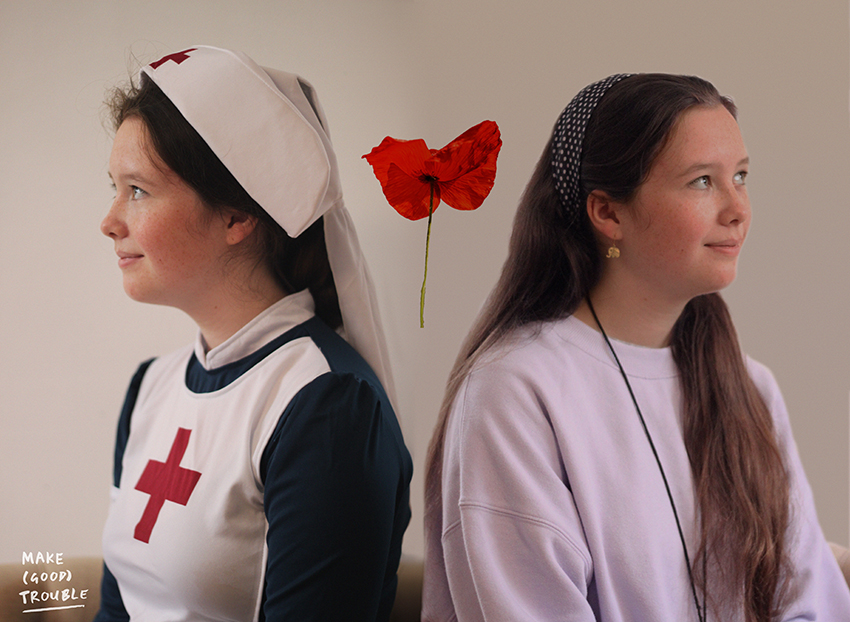
I was delighted when Daisy scheduled a meeting to discuss my involvement with Make (Good) Trouble. She explained how revered the enterprise has become, securing a donation from Sussex Police. “We have Project Poppy coming up, which looks at women’s mental health in the First World War. It’ll be perfect for you.”
My Grandad is a Holocaust survivor, so I am familiar with the impact of war. A survivor of three camps, Grandad has harrowing memories which he seldom discusses. He was taken away from his mother as a child, and never saw her again. Nobody knows what became of her. A story lost.
Indeed, the impact of war on women is rarely considered. I realised that in learning about the First World War, the experiences of wives, of female nurses and doctors were not taught. With a Mum who won the NHS “Woman of the Year” award, I know how strong women are. It is imperative that the stories of these heroes be told.
Meeting with Tayler, Daisy’s sister and project leader, I was amazed at her research and determination to bring the project to fruition. “Mental health is a current issue”, Tayler said. “We want young people to get involved and to compare mental health then with what’s happening today. We want everyone involved in the project to help build a picture of a fictional woman, Poppy, who lived through the War and use media to flesh out what her experiences might have been, to bring her to life.”
This project is part of the First World War Centenary, a programme set up by the National Lottery Heritage Fund that aims to help people understand the war, uncover its stories and explore what it means to us today, creating a link between then and now. Project Poppy participants will research the subject and create a film and a blog detailing the process, plus a presentation for schools.
Students at Hove Park School are participating in the project and we met up with them before the schools were closed due to the coronavirus. I was struck by the young people there, their compassion and confidence as they created diagrams of influences on mental health, both in the First World War and now. “Have you ever had mental health issues?” one girl asked. “Most of us have.” I was confused: happy with her openness, but sad at the prevalence of mental health issues she had expressed.
Walking home from the school that day, I was lost in thought. Isn’t it great how open young people are about mental health now, actively wanting to enact change? I smile. One thing’s certain: It’s incredible how interrupting someone’s cooking caused me to get involved with such an inspiring project.
Jan Edwards
We’re having to re-think Project Poppy due to the coronavirus lockdown. Make (Good) Trouble is now looking at ways to share the project online which will mean that more young people can get involved if they’re interested. Watch this space!