First up, apologies for the missing August round up. Holidays got in the way! The good news is that we’re back and have a bumper issue for you covering the news over the last few weeks! So grab a cuppa and dive in…

In this month’s post:

  • Teen wellbeing is still declining, with the cost of living crisis and post pandemic fall-out likely to blame. 
  • School absences are on the rise – perhaps it’s time to listen to young people?
  • Being human – why we’re really looking forward to the Brighton Summit

How are our teens?

We’ve spent the last couple of weeks talking to young people for our upcoming series of Raising Teens (broadcast on BBC Radio Sussex and Surrey this autumn). Every conversation we have with a young person gives us a better understanding of their needs and issues. It means we can work together to find ways to help. We’ll have more details in next month’s post.

As I was putting the finishing touches to this post, the Education Secretary announced that they’re planning to ban mobile phones in schools in England. They say it’s to address behavioural and mental health concerns. Much of the news about children and young people in the last couple of months has centred around a drop in happiness and wellbeing. The effects of the pandemic and cost of living crisis has been huge. The BBC published a poll last month that highlighted many of their concerns. It made for fascinating reading. 44% of girls and 24% of boys said they feel unsafe on the streets, over a quarter said they feel anxious most or all of the time – exams, school and peer pressure were the top 3 reasons. On the plus side, 66% said they felt positive about the future. 

We covered some of these issues in previous episodes of Raising Teens – and young people and professionals shared some great advice. Listen here: Raising Teens: Personal safety and Raising Teens: Anxiety.

School absences are on the rise

There were plenty of news articles about the rise in persistent school absences. 

“22.5% of pupils were recorded as ‘persistently absent’ (defined by the Department for Education as missing 10% or more of possible school sessions). This equates to around 1.6 million pupils.” (House of Commons Research Briefing, 29 September 2023) 

When looking for reasons why, some point to a change in parental attitudes since the pandemic. Schools Week reported today that there’s been a rise in home schooled children that perhaps points to disaffection with the school system. Whatever the reason, many families are struggling to cope and it’s hitting the poorest hardest – “37.2% of free school meal eligible pupils were persistently absent compared with 17.5% of pupils that were not eligible” – with a knock-on effect of lower attainment for those absent pupils. A recent IPPR paper looked at the need for wholesale changes in education to make it fit for 21st Century needs. In particular, they argue that a shift is needed in our school system – one that moves from “a system that disempowers young people” to one that “gives young people voice and agency.” We agree that it’s time to listen to young people. Their feedback is vital to inform the future of education. 

If you’re worried about your child’s school attendance and need help, take a look at Not Fine in School. It’s a great resource for parents and carers worried about their children’s school attendance. It was set up by parents who have experienced these issues. 

Human: Looking forward to the Brighton Summit

It’s been 5 years since we started Make (Good) Trouble (five years! Time flies). It started from an idea Daisy (my sister and co-founder of MGT) put to an audience at The Brighton Summit. We had an overwhelming response. Five years on, and we’re back at the Summit with Daisy as MC! It’s a great event and we’re really excited about this year’s theme: Human. The focus is on human resilience, courage and kindness, on human centred businesses. This is at the heart of MGT, building human connections between young people and parents, carers, families and the professionals who are trusted with their care. We’ll cover some of the debates, issues and ideas in next month’s round up.

Help and advice

We’ve been adding to our Help & Advice pages over the summer, so if you need somewhere or someone to turn to, take a look. The pages are full of great resources and organisations, many of whom we’ve worked with over the past 5 years. If you have any great resources you think we should add, let us know.

Till next month! Keep well. x

P.S. The image at the top of this page is from our August summer club – participants had been helping with pruning and conservation in the South Downs National Park. The SDNP team, MGT and participants showing the fruits of their labour. ♥️
Make (Good) Trouble and Sussex University are thrilled to announce the award winning comic and audiobook Sci-Fi series, The Rez has been awarded a PSHE Quality Mark for their new teaching guide and school lesson plans for Key Stage 2.

Make (Good) Trouble worked with the PSHE Association, Sussex University and educators to develop the lesson plans which support teachers in delivering lessons on kindness as part of PSHE education. The guides are designed to create a safe and engaging learning environment in which to teach about kindness and communication

“Our research shows that unfortunately a significant proportion of children are frequently on the receiving end of bullying behaviours. Developing empathy and encouraging kindness can make a big difference when it comes to bullying, so resources that support teachers to bring this into their classroom this are extremely valuable.”  Martha Evans, Director of Anti-Bullying Alliance

The Rez was developed by UK Comic Book Laureate Hannah Berry and a team of writers and psychologists, including Robin Banerjee, Professor of Kindness and Head of Psychology at University of Sussex. 

This comic book contains pro-social and emotional well-being messaging about friendship and kindness, designed to help young people prepare to negotiate emotional difficulties and stresses.

The Rez’s heroes are played by Karl Queensborough, who played Hamilton in the West End show of the same name, and Emily Burnett, Children’s BAFTA award winner.

👉 Download the lesson plans here!

The Rez is produced in collaboration with: 

Make (Good) Trouble CIC
University of Sussex
PHSE Association
Arts Council England
University of Brighton
Hopscotch
Anti Bullying Alliance
Periscope
Millipedia

We are delighted to offer a new Make (Good) Trouble Summer Club this August in partnership with East Sussex County Council Holiday, Activity and Food Programme. It’s for children aged between 12 and 16 and entitled to benefits-related free school meals. The course is free. 

If your child is interested, you can find out more here and apply. Please pass the link on to anyone you know who might like to come along.

The Club runs from Monday 2 August to Thursday 26 August 2021

Our Summer Club will provide fun and creative Media Production sessions led by young people. 

ACTIVITIES INCLUDE:

  • Creating short films using editing and audio skills
  • Learning interview skills
  • Photography including composition, shot lists, editing
  • Creating content for social media including graphics and video
  • Sound recording and editing
  • Sound effects and music integration
  • Research skills

Children attending the sessions will also have time to engage in outdoor activities each day in order to maintain a healthy balance of exercise and team building.

The young makers who attend the club will be awarded Digital badges for their CV on completion of this project. Make (Good) Trouble is a partner of the RSA Cities of Learning programme, designed to provide practical pathways to employment. In 2020 we awarded 54 Cities Of Learning Digital Badges, accredited by City and Guilds, to young people across the South East.  

Times and dates: 11am-3pm, Monday to Thursday, 2-26 August 2021

Ages: 12-16 years

Location: Westfield House, East Sussex County Council, County Hall, St Anne’s Crescent, Lewes, East Sussex, BN7 1UE 

  • Help with transport to the location can be provided. 
  • Lunch and beverages will be provided. Please let us know of any dietary requirements.
  • All our Make (Good) Trouble team are DBS checked, risk assessments completed, and Covid Guidelines will be followed. 
  • We have places for a maximum of 10 young people, on a first come, first-served basis
  • Parents/carers can sign up their children by completing our form (please note, we only have 10 places and will let you know by email if you have secured a place). 

Anne Longfield’s final speech today as Children’s Commissioner for England put children front and centre and asked the government if it is “serious about ‘building back better’ and ‘levelling up’?” Anne had a lot to say about the need for better care for vulnerable young people whose problems have been exacerbated by Covid.

What really struck a chord with us was Anne’s point that “the system needs to help professionals develop relationships with children.” And whilst this might seem like a no-brainer, she also said, “I have been shocked to discover that many officials have never met any of the children they are responsible for.”

This point is fundamentally at the heart of Make (Good) Trouble’s ethos, which is to give young people a voice, and to give them agency in their own lives and their futures. Young people are co-creators on all our projects, giving them new and transferable skills in digital media production in the process.

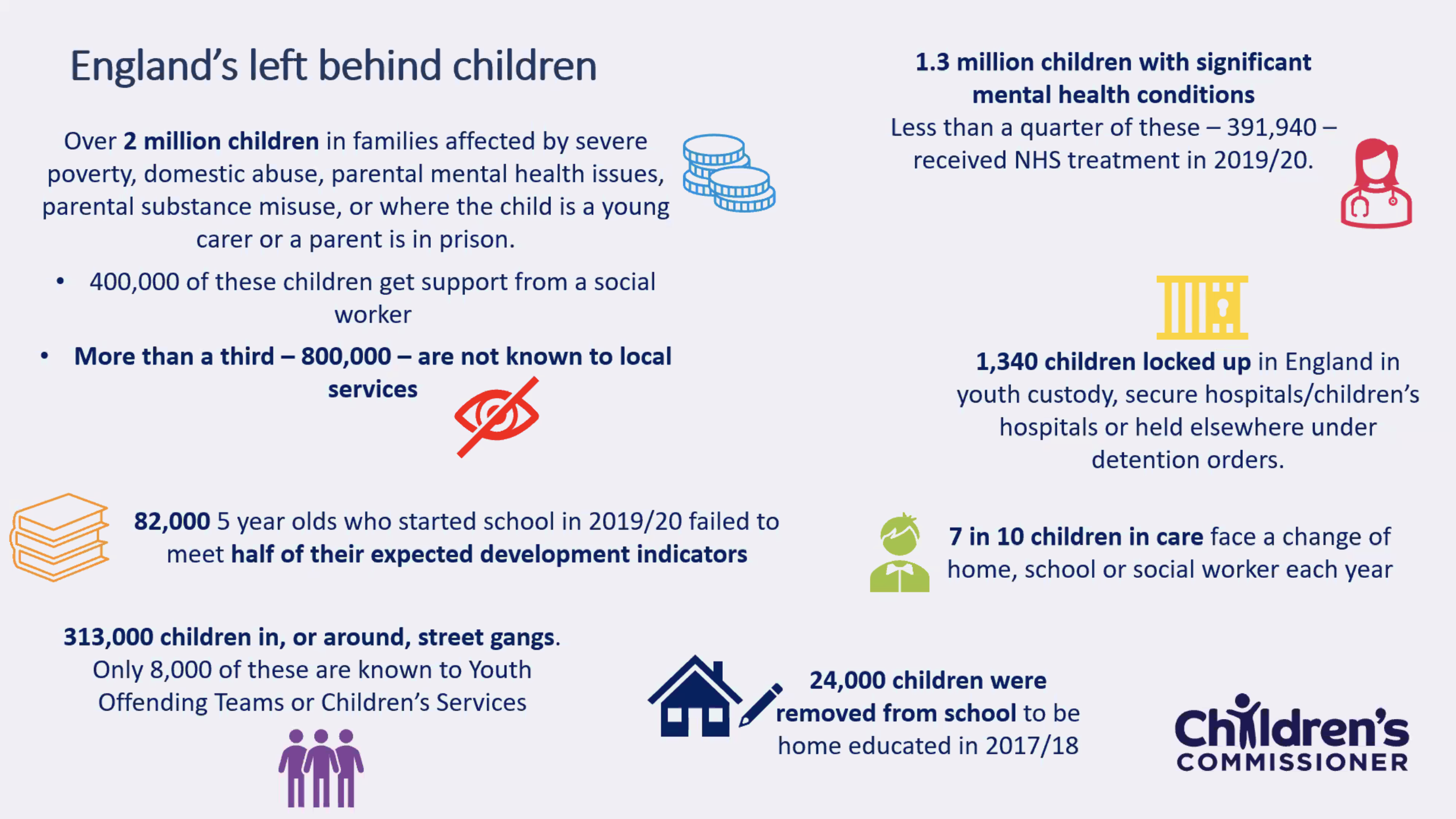
Stats on England's left behind children from Anne Longfield's final speech
Stats on England’s left behind children, slide from Anne Longfield’s final speech
Anne Longfield’s final speech as Children’s Commissioner for England

During her six-year tenure as Children’s Commissioner for England, Anne has been a brilliant champion for children. She made time to connect with Make (Good) Trouble and was interviewed by our young reporter Lola, and later by a group of teens who answered Anne’s questions.

Lola interviews Anne Longfield

Anne’s focus has been to listen to the voices of young people, and particularly vulnerable children such as those in care or those in detention “in secure children’s homes, secure training centre, young offenders institutions, mental health wards and other residential placements, either for their own safety or the safety of others”. Her focus on building up good data on children has shone a light on those in poverty or at risk of being drawn into gangs and county lines. “Vulnerable children stay in the ‘its too difficult’ box”, she said, adding, “people in charge of the system, don’t understand the needs of children”.

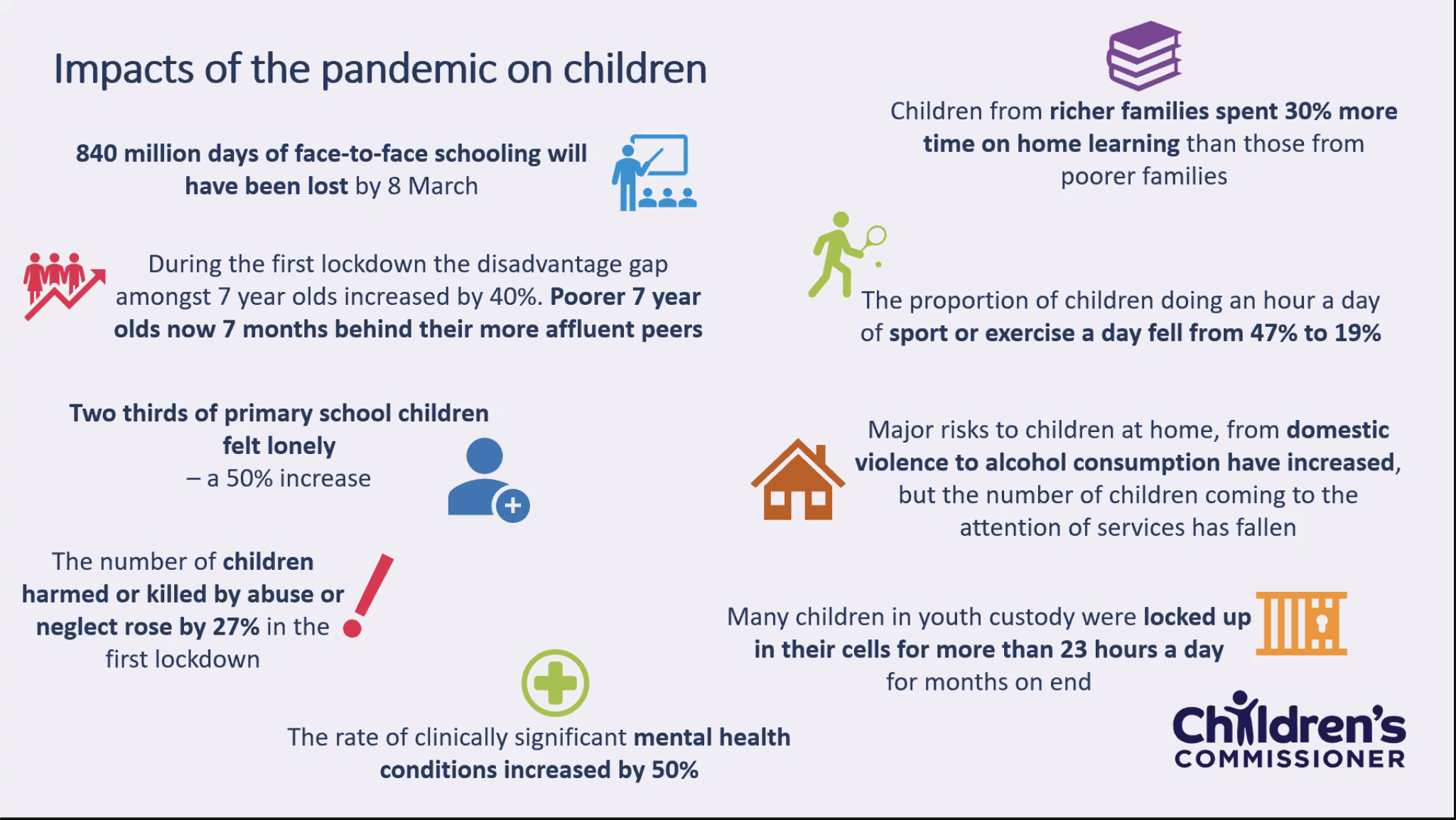
Impacts of the pandemic on children: slide from Anne Longfield’s final speech
Liv, Jude, Lola and Gemma answer Anne Longfield’s questions

If you have time, we also recommend you listen to this podcast episode where Anne speaks to children involved with Football Beyond Borders – a fantastic organisation who help children who are struggling at school by using their passion for football to engage them and improve their life chances.

Find out more about the work of the Children’s Commissioner:

The Children’s Commissioner of England website
Follow Anne Longfield on Twitter
Follow The Children’s Commissioner on Twitter
Follow The Children’s Commissioner on Facebook
Subscribe to The Children’s Commissioner on YouTube