Parenting teenagers can feel like you’re constantly firefighting – school anxiety, exam stress, messy bedrooms, emotional blow-ups – we want to say this clearly:

You’re not failing. This stage really is tough.

At Make (Good) Trouble, one thing we hear again and again from parents is:
“I don’t know what’s normal anymore, and I don’t know if I’m handling this right.”

You’re not alone in that feeling.

In this Q&A, Daisy Cresswell spoke with psychotherapist Donna Peters-Lamb about young people’s mental health, parenting teenagers – and what genuinely helps families day to day. Here are the most useful takeaways

When school feels like too much

For many families, anxiety shows up as the Monday morning battle – tears, shutdown, refusal, or a child who simply can’t get out of the door.

One reassuring truth: anxiety rarely comes out of nowhere. It builds quietly over time and is often a response to feeling overwhelmed or unsafe.

What helps (without making it worse)

Get curious, not alarmed
Instead of focusing only on “school is the problem”, try gently exploring:

  • When did this start?
  • What feels hardest?
  • When does school feel even a little bit easier?

Sometimes the clue to moving forward is hidden in the detail.

Bring school in early
You don’t need to wait for things to fall apart. A discreet conversation with a tutor or Head of Year can help you understand what’s really going on – friendships, learning pressure, or moments where your child is coping better than you realise.

Prepare before pressure hits
Anxious brains hate uncertainty. Simple preparation can make a big difference:

  • Pack school bags on Friday
  • Check homework earlier in the weekend
  • Talk through the week ahead

Less last-minute stress = calmer mornings.

Tools that actually calm anxiety

Anxiety lives in the body, not just in thoughts. These tools help switch off the stress response – and teenagers (and parents) can use them anywhere.

Breathing (simple and invisible)

  • 3–4–5 breathing: in for 3, hold for 4, out for 5
  • Or any breathing where the out-breath is longer than the in-breath

This tells the nervous system it’s safe to calm down.

Grounding

Encourage your teen to:

  • Feel their feet flat on the floor
  • Notice colours, sounds, or objects around them
  • Focus attention outward instead of inward

These techniques are subtle, practical, and effective anywhere – in classrooms, 

“They don’t listen to me”: Mess, conflict and power struggles

If you’re endlessly asking for dirty washing, mugs and plates from their room – and getting nowhere – you’re not alone.

A helpful reframe: this is rarely about disrespect. Teenagers genuinely don’t notice mess in the way adults do.

What helps families move forward

Say it once – properly
Instead of repeatedly asking the same question over and over again, have one calm conversation about:

  • What matters to you
  • What you expect
  • What will happen if it doesn’t change

Start small
Ask for one thing at a time:

  • This week: dirty clothes in the basket
  • Next step: cups and bowls returned

Small steps are more achievable – and more likely to stick.

Consequences, not punishments
Be clear and upfront:

“If this doesn’t happen, this is what will follow. I don’t want that – but it’s your choice.”

This removes power struggles and reduces emotional blow-ups.

Exam stress and the harsh inner critic

Even when exams are over, many young people stay stuck in worry – replaying papers and assuming the worst.

Psychotherapist Donna Peters-Lamb shared a powerful idea from psychologist Martin Seligman, known as the Three Ps.

When stressed, young people often make worries:

  • Personal: “This proves I’m a failure”
  • Pervasive: “I mess everything up”
  • Permanent: “I’ll always be like this”

📚 Read this: Learned Optimism: How to change your mind and your life by Martin Seligman

How parents can help

Rather than jumping in with “You’ll be fine”, try gently challenging certainty:

  • “You don’t actually know that yet.”
  • “That’s a thought, not a fact.”
  • “Even if this didn’t go how you hoped, there are other paths.”

This isn’t fake positivity. It’s helping young people build flexible thinking – a key life skill.

A few things to remember about parenting teenagers

  • Teen brains are still under construction
  • Behaviour is often communication
  • Anxiety needs calming, not fixing
  • Routines, sleep and connection matter more than lectures
  • Your stress level affects your child more than you realise

And most importantly:

Be kind to yourself.
Parenting teenagers is one of the hardest, most emotionally demanding jobs there is – and you don’t have to do it perfectly to do it well.

At Make Good Trouble, we exist to support parents and carers too. You don’t have to hold all of this on your own.

Want support that feels human?

If this resonates, you might find it helpful to:

  • Sign up for our Raising Teens workshop pilot
  • Follow us for practical tools and honest conversations
  • Share this post with another parent who might need it

💛 You’re not alone. And you’re doing better than you think.

Huge thanks to Donna for her time and invaluable advice. You can find out more about her work at Make Sense Psychotherapy. This programme was supported by the Sussex Care Partnership, Brighton & Hove City Council.

Watch the whole conversation here:
Orchids, Poo Sprinkles and Us…

That’s the name of one of the podcasts created by work experience students detailing their experiences of their placement week at the glorious botanic garden, Wakehurst, in Sussex, part of the Royal Botanic Gardens, Kew. So if you’re interested in finding out what poo sprinkles are, give them a listen (below)!

They created the podcasts on the final day of their placement with Make (Good) Trouble. Our one-day workshop is designed to help young people to make sense of their work placements, articulate what they’ve learnt, and sharpen their communication, and listening skills. It also helps them to prepare for future job interviews. 

We were invited to devise and deliver a workshop that encourages young people to think about all the things they have learnt on their placement, and to disseminate that into a podcast and written piece for their CV. We also included training in interview techniques and how to use audio recording equipment, which they loved! The groups recorded interviews with each other, describing their week, as well as sound effects from the gardens to help build an aural picture of their experiences.  

The result is two amazing podcasts. We could hear how they had thrived at Wakehurst, working in different areas of the organisation – from marketing, education, and horticulture to the Millennium Seed Bank and the Visitor Centre. (It’s something I’d have loved to have the opportunity to do when I was younger!)

“You’ll definitely enjoy this experience if you’re interested in conserving nature and protecting the planet, because it makes you feel that you’re actually making a difference.”

“My top tips for the next person doing the Horticulture Department would be – just be prepared. You will not want to leave. At least I have not been wanting to leave. And I really want to come back here and volunteer and possibly get a job later on.”

So grab a coffee and listen to the brilliant work of these young people. 


👋 If you’re interested in us augmenting your organisation’s work placements with a Make (Good) Trouble workshop, let us know!

🌳 Wakehurst work placements are open to young people aged 14-18. Contact wakehurstworkexperience@kew.org for information on how to apply.

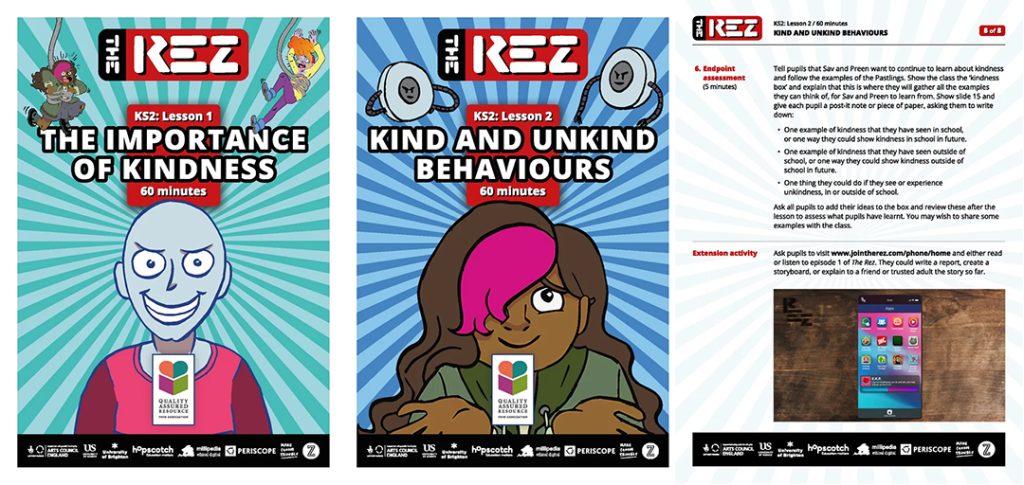
The Rez is an exciting collaboration between academics at the University of Sussex, Make (Good) Trouble and Arts Council England. It is a sci-fi podcast adventure for 7–11-year-olds told through a comic book and a game-based website, designed to help young people prepare to negotiate emotional difficulties and stresses. The Rez is created by recent UK Comic Laureate Hannah Berry, alongside a team of writers and psychologists. 

Make (Good) Trouble was engaged to produce content to raise awareness of The Rez, including a Key Stage 2 lesson pack, Quality Assured by the PSHE Association, which has now been updated to include alternative options for pupils with Special Educational Needs and Disabilities (SEND). Over 1.5 million children have special educational needs, according to government statistics – an increase of 87,000 on 2022. 

Teaching about kindness supports pupils with SEND in meeting learning outcomes around ‘Self Awareness’, as outlined in the PSHE Association’s Planning Framework, and helps teachers to cover statutory content about ‘Caring friendships’ from the Department for Education’s RSHE guidance. You can find more about teaching safe and effective PSHE education for pupils with SEND on the PSHE Association’s website. There’s also a super-useful teacher’s handbook for embedding inclusive practice around SEND in schools.

We felt it was important for to work with the University of Sussex and the PSHE Association to develop guides and lesson plans that include pupils with SEND. We work with a lot of young people who have additional needs, and it’s great to offer more practical support and visually engaging content to enhance their experience in the classroom.

“We were delighted to work with The Rez and Make (Good) Trouble on this project. The story and bright visual aspects of these lesson plans will help teachers appeal to pupils’ imagination throughout and help them to explore the topic of kindness a fun and engaging way.” 
 Liz Laming, Senior Subject Specialist, PSHE Association.

“Working with Make (Good) Trouble to develop lesson plans for our PSHE Association-accredited adolescent well-being project has made all the difference to our outreach. It has literally opened the doors to hundreds of schools for us. This means potentially thousands of students are being resourced to support their own mental health and to have healthier media diets. Our impact would have been a fraction of what it is without Make (Good) Trouble. We are working with them on a second set of lesson plans and look forward to working with them on new projects we are developing. They are great!” 
Martin Spinelli, Professor of Podcast at the University of Sussex and Director of Rezilience Ltd.

Get in touch if you’d like us to support you with the development and distribution of PSHE education lessons.

👉 Download the lesson plans here!

👉 jointherez.com

The mental health crisis in young people is escalating, and in this episode of Raising Teens we look at what mental health support is available in schools. Long-term, children and young people who struggle with their mental health are more likely to have poorer physical health and economic outcomes than their peers.

We hear from young people about their experiences of mental health support in school:

  • “For me, going to see a counsellor, it felt really welcoming and it didn’t feel like I was aiming to completely fix my emotions. It felt like I was understanding them better, which I hadn’t realised I needed to do… I feel like I just understand emotions a bit more. I understand how I work, how I think, which I think is really helpful to anything else that I might experience in the future.”
  • I had two teachers that I was really close with and I’m still close with now. I felt comfortable with them, but they weren’t the pastoral team. They weren’t people that were trained in a way to help me cope with my mental health issues. Comfortability-wise, the pastoral team weren’t people who I could really see myself going up to and asking for help.”

We discuss how schools can help to improve the outlook for our young people, what help children are entitled to and whether schools are equipped to provide that support and help prevent the need for clinical treatment. It’s not known how many children are educated at home, but in  a report this week from Schools Week, it’s estimated that there has been a rise of 60% since the pandemic. What support can home-schooled young people expect?

🎧 Listen to Raising Teens: Support in Schools on BBC Sounds.

Our expert guests for episode 6 are:

If you’re wondering how parents can support their teens, and how we can make sure that support is accessible to every young person that needs it, tune in to BBC Radio Sussex and Surrey, and BBC Sounds on Fridays at 7pm or catch up any time on BBC Sounds. 

👉 Find out more about Raising Teens and listen to past episodes: Raising Teens.

👏 Raising Teens series 5 is supported by NHS Sussex.

Help and support:

If you/your child needs help, their first port of call should be your school’s pastoral team. Outside of school, the following services might be helpful.

e-wellbeing, Parent and young people Mental Health Support

YMCA Dialogue Counselling Services, accredited by The British Association of Counselling & Psychotherapy.

AudioActive, non-profit organisation based in Brighton and across Sussex offering free drop-in sessions and workshops for young people based around music.
AudioActive also offer: 

  • Shift programme in schools
  • Room to Rant – “a space for young men to rap and get stuff off their chest”,
  • Vocalise – “a weekly drop in where all young women and gender variant individuals can put life experiences into music in a safe space”.

YMCA DownsLink Group offering mental health services and counselling for children, young people and families in Sussex.

Brighton & Hove Wellbeing Service, a free NHS service for anyone aged 4 years old and upwards with a postcode beginning BN1, BN2, BN3 or BN41. You can make a self-referral using this link

Not Fine In School, an organisation run by parents, “who have experienced school attendance barriers”. Their website has a ton of useful resources and information. They also host closed Facebook groups for families, professionals and school teachers.

Place 2 Be works with schools to support children’s and young people’s mental health. They have useful information for parents.

Young Minds offers help with:
Problems at School

The Student Room, community forum for advice and support for school, college and university students.

Kooth, a mental wellbeing community for young people to find online support and counselling