The joys of managing a start-up, social enterprise project are all now making themselves apparent. We’ve been knee-deep in spreadsheets, budgets, video edits, meetings and research, research, research. It’s been a fascinating if exhausting time!

Firstly a huge thank you to those who’ve answered our last-minute calls for help with everything from budget forecasting, legal to editing and music! One of the driving forces of Brighton5 has been the people who’ve rolled up their sleeves and got involved. We are forever grateful.

We’re planning our parent-focused radio show, which we hope to air on Radio Reverb this autumn – watch this space! We’re looking for parents, and experts to speak or contribute their stories on everything from teen stress and mental health issues to body confidence and technology and device addiction. Please get in touch if you have a story, question or issue we can discuss. Onwards!

As part of our ongoing research for Brighton5, we speak to those responsible for supporting children in some of Brighton’s biggest schools and colleges. We’re particularly interested in children’s mental health, one of our core focuses for the project. A recurring theme in our discussions is the lack of preventative approaches (and immediate referral support and resources). This means that, whilst warning signs are heeded, kids can’t always get the right help when it’s needed – early on.

This was brought into sharp focus today when the Education and Health & Social Care Committees published a damning report on the government’s new mental health strategy. They argue that the strategy is  “failing a generation”. The World Health Organisation states that “up to 50% of mental disorders in adults begin before the age of 14 years“.

The report asks huge questions about the strategy for mental health provision, answers to which are missing from the government’s Green Paper.  There’s a lack of focus on prevention, there is little joined up thinking on how different departments will work together, including a soloed culture –  all of which has been exacerbated by cuts in services and a lack of funding. They say there’s a woeful lack of data around  what provision is currently available in schools, an overstretched staff and issues with recruitment & retention, meaning that it’s unclear how the government will successfully implement the strategy – which the proposal seems to be to fund it from “within” existing budgets.

They also argue that the plan will take too long to implement leaving kids out in the cold – only 20-25% of the UK will be reached within 5 years.

At this point my blood was boiling. Our kids need help right now. Ten percent of 10-15 year olds in schools have mental health problems. We really can’t wait that long.

When we spoke to safeguarding staff for schools and colleges in Brighton, they told us that:

  • Reported cases of mental health issues have increased exponentially in recent years
  • Rates of anxiety in children have rocketed, with a notable change after exams were introduced in primary schools [which schools minister Nick Gibb refutes – he seems to think that more exams are the answer!?]
  • Politics is adversely affecting education with swings in policy each time a new government is voted in has a huge effect on kids. Education should be free from political see-sawing.
  • The amount of social media related problems have sky rocketed. Kids have very low awareness of what should and shouldn’t go on social media -bullying and body image issues need addressing.
  • Funding for wrap-around courses has been stripped back. The exam system is now academic, paper-based and test-heavy – if this is the measure of success, it disenfranchises a large number of kids.

One safeguarding staff admitted: “We have to wait until it’s all gone wrong before kids are eligible for the right level of support, but some of these issues are preventable – parents and teachers can often see it coming. The system is combative instead of preventative”.

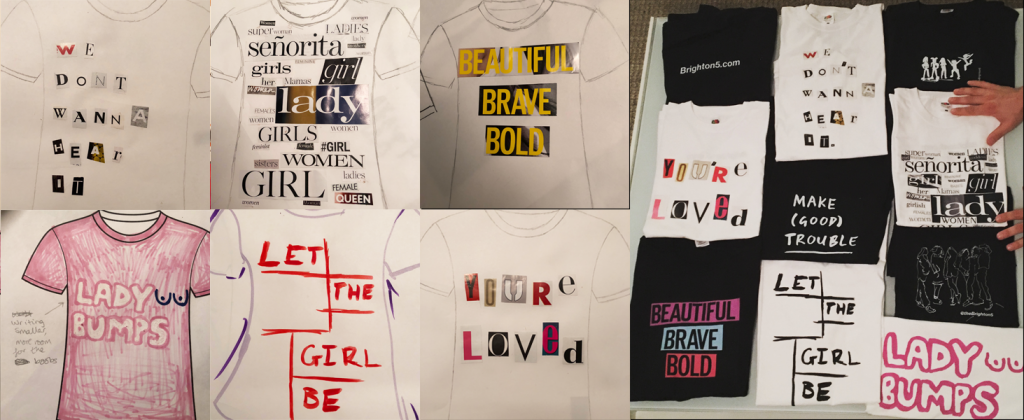
Brighton5 t-shirt designs
Our teens designed t-shirts – don’t they look great printed!

We’ve been keeping an eye on the weather as Saturday approaches. It’s D-Day for filming our crowdfunder. We’ve been amazed at the huge amount of support people have given us, from directing the shoot, providing equipment and speaking on camera to photographing the events of the day and offering to make teas. (Thank you all!) Some of our teens have even signed up for getting up at the crack of dawn to get a shot of the sunrise on the beach!

We’ll be wearing our brand new Brighton5 T-shirts, all designed by our teens. (Suspect there’ll be a bit of a bun fight over who gets which one!)

We’ll post updates over the day on social media – Twitter, Instagram and Facebook – so give us a wave!

The on-going revelations about Facebook and Cambridge Analytica’s doings has made me wonder how much attention teens are paying to what it all really means for them. When I asked my teen what she thought of it all when the revelations broke, she was non-plussed. What revelations?

And whilst we’ve seen myriad news and think pieces about the issues, how much of it is aimed at the heaviest users of social media – young people? Not much, I suspect.

We’ve seen old white men addressing Facebook’s CEO Mark Zuckerberg in Congress in the US last week showing just how much they don’t get about the platform and how it works. There’s been a discussion about “Facebook embeds”  (Facebook staff embedded in political campaign teams to help them optimise their strategies) which has huge implications for how the electorate in everything from the US election to the EU Referendum may have been manipulated. There has also been many accounts from people who’ve managed to download the umpteen gigabytes of data from their Facebook and Google accounts revealing just how much is tracked and kept – every link we click on, every map we search, every email… including news that mobile phone text messages had been scraped from Facebook user’s data (why was Facebook holding that data anyway??).

“The covert nature of persuasion on the social web means that effective marketing is no longer something you can see or even perceive, but something which through a thousand “touch points” might subtly change your behaviour without your noticing.” Emily Bell, The Guardian, 16 April 2018

My teen is of voting age. How many of them (and us) have been fed unscrupulous political ads from dubious “news” pages on Facebook and the like? How much personal information are our teens giving away from their ubiquitous use of social media? And more importantly, how much do they understand about the exchange of a “free” service for their data? Who has the power here?

Facebook seems to be cleaning up its act in a hurry. Their share price tanked in recent weeks (though it rose again after Zuckerberg’s Congress appearance). New European data privacy laws mean that they have to act in any case. It’s good to see they’ve drafted clearer terms and conditions (hands up who’s read any social platform’s T&Cs? Would your 13 year old understand them?) and last October they announced they were launching a public archive of political adverts  so we can all see (presuming we’re interested enough to go look) who’s behind what.

Let’s not forget that there are some brilliant people doing amazing work by using social media platforms to bring communities together. But we also need to teach our kids (and perhaps ourselves) to be sceptical and inquisitive about these platforms, to ask the questions about who owns what and what we’re exchanging for a so-called “free” service. We’ve put this one high up on the Brighton5 to do list. Watch this space.