As part of our programme of parent and carer get-togethers – our amazing beach walks – we spoke to psychotherapist Donna Peters-Lamb about teen mental health, wellbeing and tips for dealing with:
school stress
anxiety and exam stress – including how to speak to your teenager and the school about anxiety
the teenage brain – when teens seem like they just don’t care!
how to manage conversations around their mental health
breathing techniques for de-stressing
sleep and creating a better sleep routine
setting boundaries and expectations – around what we expect as parents, and what our teenagers expect
how to look after ourselves
and the benefits of having ‘worry time’.
It’s a fascinating discussion, so grab a cuppa and dive in!
This project has been supported by the Sussex Care Partnership, Brighton & Hove City Council
For further help & advice
If you need further help or advice, check our Help pages – they cover lots of different topics. (If we’ve missed something, let us know!)
We’re super excited to be running our summer club again this July/August as part of the East Sussex Holiday Activities and Food (HAF) programme.
Our clubs are planned and run by young people, alongside our experienced team. We have a range of activities planned centred around audio recording and photography. We have trips planned around the East Sussex countryside and seaside. We will go on nature walks and try out taster sessions for paddle-boarding.
Attendees will have the chance to document their experiences at the club. They will gain skills as roving reporters, with the sound footage edited to create our very first HAF podcast!
We will host safe outdoor cooking sessions (weather permitting), such as BBQs with healthy homemade menus designed by and for the children.
At The Joff, Peacehaven.
The club will run from 11am to 4pm, Monday to Thursday, from 25 July to 4 August.
Our two-week summer club is free to young people in receipt of benefits-related free school meals (FSM).
This project will give children the opportunity to make good memories, during one of the most uncertain times in recent history, as well as teaching them valuable transferable skills in media production, confidence, team building and hands on learning.
⭐️ “I’m gonna miss everyone a lot, including the grown upsI” Attendee feedback, Summer 2021
⭐️ “I’ve been coming for the whole summer (4 weeks), I was meant to go on holiday but decided to stay at the club instead.” Attendee feedback, Summer 2021
⭐️ “He came home happy every day and I can’t thank you enough for that.” Parentfeedback, Summer 2021
⭐️ “The fact that she’s had an opportunity to try [photography] out for herself and has just loved it is really, really great, because it could be more than a hobby for her.” Parent feedback, Summer 2021
I’ve followed women’s football for the past decade. Ten years ago, if I couldn’t make it to a match in the top flight of women’s football, I’d have to resort to following the action on Twitter, looking for anyone who was tweeting ball-by-ball coverage (hello Girls on the Ball, @Stillberto!). There was no TV coverage, no FA Player streaming matches. There was little to no coverage in the national press, and scant information about players, managers, tactics, strategies – all the things that make following the game interesting and exciting. But times are changing.
It really feels as if we have reached a tipping point. After a 50-year ban by the FA between 1921 and 1971 (their view was that football was “quite unsuitable for females”), with women resorting to forming their own leagues and tournaments, playing in boys’ teams in boy’s or men’s kits, the tide has turned.
Over 1 billion people tuned in to watch the 2019 Women’s World Cup and for the first time England’s women had their own bespoke kit. In April 2022, 91,648 fans filled Camp Nou to see Barcelona Women take on VfL Wolfsburg in the Champions League semi-final. And with the Women’s Euros about to kick off in July, we’re going to see an explosion of coverage (at last!) of the women’s game.
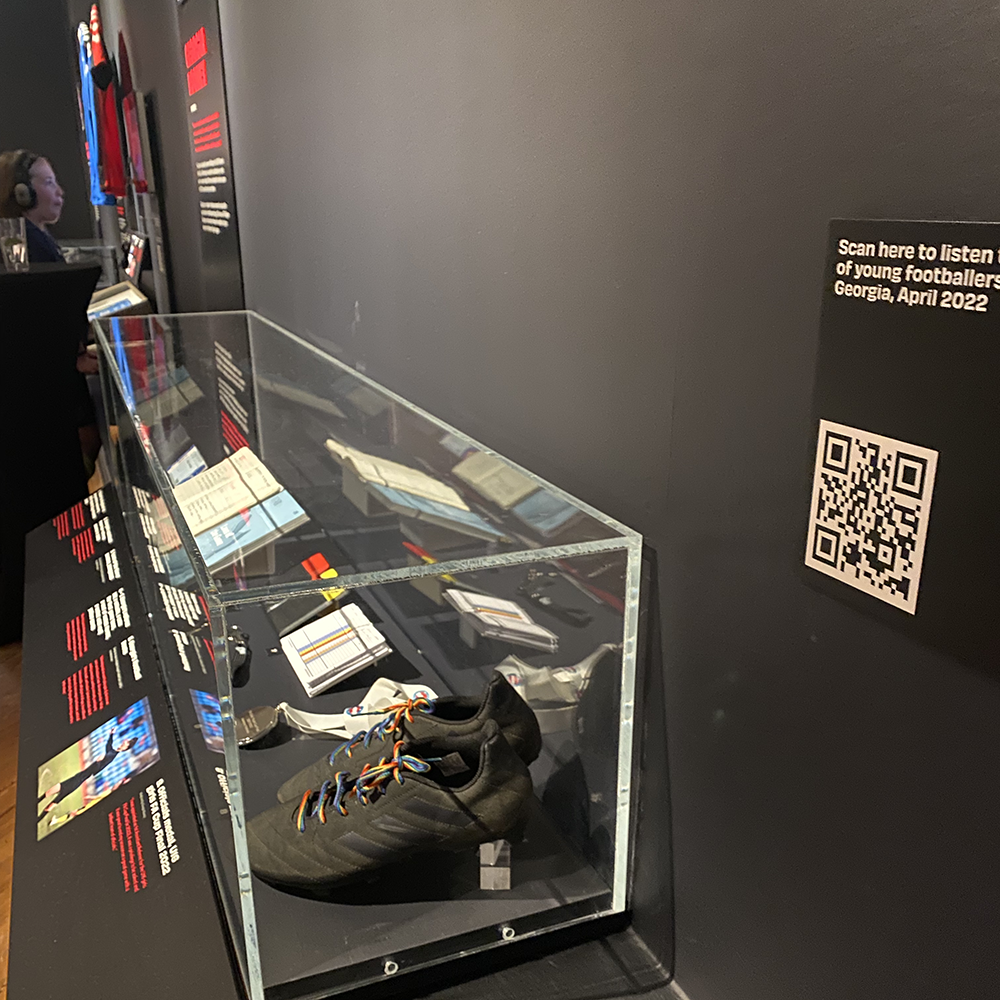
This summer, get yourself down to Brighton Museum. You’ll be treated to an amazing exhibition, Goal Power! Women’s Football 1894-2022, dedicated to the unstoppable rise of women’s football over the last 100 plus years. They have a fantastic array of memorabilia, from the uncomfortable-looking boots worn by munitions worker Fanny Williams in 1921, to Brighton General Post Office team programmes, shirts and trophies from the 1960s and ‘70s, and (for the first two weeks) the 2022 Women’s Super League trophy. The exhibition runs to 25 September 2022.
You’ll also see a few QR codes that link to some fascinating interviews that Make (Good) Trouble helped to create…
Take your headphones to the Goal Power! exhibition at Brighton Museum and hear stories from the likes of referee Georgia Rooney about her part in the beautiful game
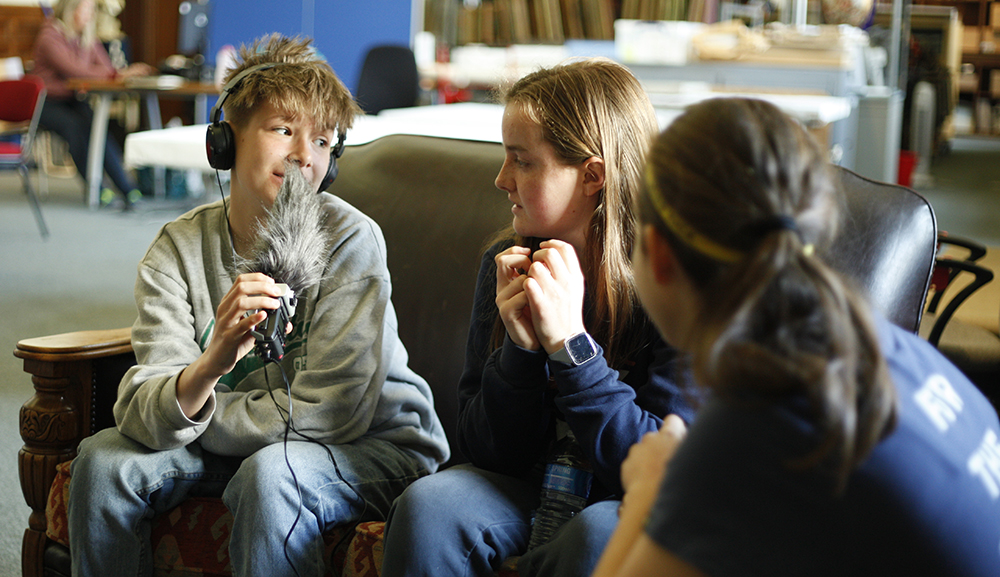
In April, Make (Good) Trouble worked alongside photographic artist and artist facilitator Lindsey Smith, to help seven young players, aged between 12 and 14, interview legends of the game, and those working in and playing football today. The resulting podcast series gives us real insights into what it was like to be a player in the 1960s and ‘70s, and how that is changing for those involved in the game today.
The interviews
A fascinating conversation between young female footballers from Sussex
“My dream was that I would be playing in a cup final at Wembley… That was a dream that was never going to come true, but now it’s different. Girls have played at Wembley.”
Petra Landers, German international player was part of the team that won the Euros in 1989. The German FA infamously presented their triumphant team with a coffee set for winning the trophy. Today Petra is a volunteer coach and mentor working with girls in Ghana.
“I’m going into the communities [in Ghana]. I will have football camps, maybe three or four days… My friend and me, we are going through the communities by motorcycle and this will be a brilliant adventure…. I try to find sponsors and even if I don’t find them I will do it. It’s my passion, my goal, my everything.”
Georgia Rooney, a professional referee and trainer. Inspired by seeing female referees at the 2019 Women’s World Cup, she Googled “how to become a referee”. Her ambition is to referee WSL and international matches.
“I always wonder because I was good when I was little, if there was anyone around who was focused on women and girls football and they’d have seen me play and thought she could go on a team or might have just fostered my interest a little bit and helped me go somewhere with it. I just wonder what a difference that would have made because no one paid any attention because no one thought that football was really for girls.”
Lewes FC’s Rhian Cleverly, Karen Dobres and Ellie Ramsauer
Rhian Cleverly, captain of Lewes FC Women and former Welsh international. She is proud to be playing for “the best team in the world”, the first, and currently only, professional or semi-professional club in the world that splits its resources equally between its men’s and women’s teams.
“It’s given me the best experiences and friendships I’ve ever had in my life. There’s been tough times, but I think it’s also prepared me, like being released [from a contract] in France – I lost my home, I had a boyfriend at the time, so we broke up, I had lost my car, lost my job, and I was like, oh, what do I do now? So now I think little things like being injured and having surgery, it’s not as big a deal… it’s prepared me for other things in normal life. So, yeah, I would say if you enjoy it and it makes your heart pump and it makes you smile, then definitely go for it because you won’t regret it.”
Ellie Ramsauer, coach for the under 14s development pathway at Lewes FC (since May 2022, Manager of Saltdean Women’s Development Side), has played football since she was 6. She works in the evenings and at weekends alongside a full-time job.
“I think boys are more pushed and girls are more excluded. I mean, if you really want to, you can get into it, but there’s not the same encouragement as there is for boys… I think when I was younger, there weren’t many girls teams, not many girls in boys teams either. When I went to watch Arsenal women, they all had men’s hand-me-down kits. I don’t think they were paid either. They never played in big stadiums. Yes, I think respect for the game has grown exponentially.”
Karen Dobres, elected co-director at Lewes FC, the first (and currently only) football team to share its resources equally between its men’s and women’s teams. She is involved with fan and community engagement and financial sustainability. She is passionate about raising the profile of the club and promoting its ethos and practice of equality.
“I think we’re a long way off equality, but I think that’s simply down to decisions in board rooms. So it’s not like there’s a lot to overcome, really, because we [at Lewes FC] had a lot to overcome when we introduced equality, but everyone seems to have come round to it. Now the sponsors are on board, right? And our men’s team have definitely not suffered. They’ve also been promoted. It’s an important thing to say.”
https://www.instagram.com/p/Ce3lz3rIL0o/
👏 Take a look at Lewes FC and see the brilliant work they’re doing to promote equality.
We have a brand new four-part series of Raising Teens for you this February. You can catch it on BBC Radio Sussex, BBC Radio Surrey at 9pm every Monday in February. And on catch up on BBC Sounds. This series looks at some difficult but important subjects including teen safety, drugs, and the pressures young people feel that might induce them to run away from home. We look at the issues involved and our expert guests offer practical advice and tips for parents and teens looking for support.
In episode one, we discuss teen safety. We hear from young people with candid stories about their experiences of harassment, street crime, and how friends help each other to keep safe.
Episode two looks at county lines. The Children’s Society describes county lines as “a form of criminal exploitation in which criminals groom and manipulate children into drug dealing. The ‘lines’ refer to the mobile phones that are used to control a young person who is delivering drugs often to homes outside their own county”. This topic was a real eye-opener for us. We hear from a young man who was drawn into drug dealing and has since taken the decision to help other young people to understand the issues and avoid the same fate that he experienced.
Our expert guests will look at the effects of county lines on families and communities, and discuss how parents can spot the warning signs of their child being groomed by a gang, and the support that is available. Guests are Lee Tully, Youth Worker; PC Keith Beckley from Sussex Police; and James Houghton, Director of Future Voices, a Training, Development and Consultancy organisation for those working with children who suffer exploitation/extra familial harm.
Episode three is all about cannabis. We hear from young people who told us that they think cannabis has become “normalised” and a rising problem in Sussex. We discuss how cannabis affects the teenage brain, how young people can get help if they feel that cannabis is negatively affecting their life, whether cannabis should be legalised, and what support is available.
Guests are Carl Scott, qualified drug & alcohol support worker and founder of Project Youth; Luci Hammond, Adolescent Health Worker from RU-OK? a young people’s substance misuse & sexual health service for Brighton & Hove; and Sergeant Scott Gosling from Sussex Police.
Our final episode looks at the pressures young people might be under and what happens when that tips over into them running away from home. We speak to young people about their experiences – and they tell us candidly why they might think about not going home, and to the parent of a teenager who repeatedly ran away. She tells us how it affected her and her family and what steps she took to support her child.
Our guests are Paul Joseph, Head of Helplines at Missing People; Eli Adie, West Sussex Youth Hub Development Manager from YMCA Downslink Group; and Sergeant Scott Gosling from Sussex Police.
Raising Teens is hosted by presenter Guy Lloyd and includes teens’ own stories from Make (Good) Trouble’s young reporter Lola Ray, with additional reporting from Xenith Pocknell and Hamzah Ali. We hope you’ll join us at 9pm every Monday in February 2022 on BBC Radio Sussex, BBC Radio Surrey and BBC Sounds.
We use cookies on our website to give you the most relevant experience by remembering your preferences and repeat visits. By clicking “Accept All”, you consent to the use of ALL the cookies. However, you may visit "Cookie Settings" to provide a controlled consent.
This website uses cookies to improve your experience while you navigate through the website. Out of these, the cookies that are categorized as necessary are stored on your browser as they are essential for the working of basic functionalities of the website. We also use third-party cookies that help us analyze and understand how you use this website. These cookies will be stored in your browser only with your consent. You also have the option to opt-out of these cookies. But opting out of some of these cookies may affect your browsing experience.
Necessary cookies are absolutely essential for the website to function properly. These cookies ensure basic functionalities and security features of the website, anonymously.
Cookie
Duration
Description
cookielawinfo-checkbox-analytics
11 months
This cookie is set by GDPR Cookie Consent plugin. The cookie is used to store the user consent for the cookies in the category "Analytics".
cookielawinfo-checkbox-functional
11 months
The cookie is set by GDPR cookie consent to record the user consent for the cookies in the category "Functional".
cookielawinfo-checkbox-necessary
11 months
This cookie is set by GDPR Cookie Consent plugin. The cookies is used to store the user consent for the cookies in the category "Necessary".
cookielawinfo-checkbox-others
11 months
This cookie is set by GDPR Cookie Consent plugin. The cookie is used to store the user consent for the cookies in the category "Other.
cookielawinfo-checkbox-performance
11 months
This cookie is set by GDPR Cookie Consent plugin. The cookie is used to store the user consent for the cookies in the category "Performance".
viewed_cookie_policy
11 months
The cookie is set by the GDPR Cookie Consent plugin and is used to store whether or not user has consented to the use of cookies. It does not store any personal data.
Functional cookies help to perform certain functionalities like sharing the content of the website on social media platforms, collect feedbacks, and other third-party features.
Performance cookies are used to understand and analyze the key performance indexes of the website which helps in delivering a better user experience for the visitors.
Analytical cookies are used to understand how visitors interact with the website. These cookies help provide information on metrics the number of visitors, bounce rate, traffic source, etc.
Advertisement cookies are used to provide visitors with relevant ads and marketing campaigns. These cookies track visitors across websites and collect information to provide customized ads.