Helping young people find their voice
Hands-on oracy workshops from Make (Good) Trouble and Dragon Drama build young people’s confidence in speaking, listening and being heard. Using our Green Room Framework, young people work in small crews to make something real, from a podcast to a speech.
Flexible timing · Ages 10–18 · Groups of up to 30 · Delivered across England or online
In summary: Our oracy workshops help young people speak up with confidence, listen well and get their ideas across. They’re run jointly by Make (Good) Trouble, a social impact company with years of experience in youth voice and public speaking, and Dragon Drama, a theatre company specialising in improvisation and play since 1993. Using our Green Room Framework, young people work in crews of three to make a real media project, taking turns as producer, interviewer and interviewee. Timing is flexible, from a weekly lesson to an intensive day or two, and the workshops come at a time when oracy is set to have equal status with reading and writing in England’s national curriculum.
What is an oracy workshop?
An oracy workshop is a hands-on session that helps young people speak and listen well: putting their ideas into words, practising critical thinking through talk, and engaging with other people.
Ours are built on our Green Room Framework, an approach we’ve developed by combining two things we know well. We have over 30 years’ experience working in the media and theatre, and we know that great conversations come from production crews, not individuals. From the rehearsal room, we know that mistakes are useful, ideas grow when you say ‘yes, and…‘, and play is where confidence starts. Put together, they give young people a real job to do, a team that has their back, and the freedom to make it their own.
The timing matters. The government is introducing a new oracy framework for schools, and oracy is set to have equal status with reading and writing in England’s national curriculum. We’ve long known how much speaking up matters for young people’s confidence, self-esteem and future working lives. (Read more in our blog: The new oracy framework: why speaking up matters for young people.)
How it works: the Green Room Framework
Real roles. Real listening. Real voices.
In TV, radio and theatre, the green room is the space behind the scenes where you get ready before you go on. It’s where you have time to think and prepare, where nerves are normal, ideas get tried out, and the people around you are on your side. That’s the space we build in every workshop.
The Trio: three roles, one crew
Every young person works in a crew of three, making something that matters to them: a podcast, a short film, an interview or a speech. Each crew member has a real job, and the roles rotate so everyone does all three.
| Role | What they do | What they practise |
| Interviewer | Asks the questions, guides the conversation and keeps it moving, Encourages the interviewee to say more about their story, and listens carefully to the words they use, picking up on them to ask the next question | Curiosity, clear questioning, active listening, thinking on your feet |
| Interviewee | Answers, tells their story, shares opinions and ideas | Expressing yourself, organising thoughts, speaking with confidence |
| Producer | Listens closely, watches the whole picture and gives feedback that makes the next take better | Deep listening, empathy, encouragement, constructive feedback |
The Producer is the heart of the model: not a judge, but a coach. Learning to listen this way is as powerful as learning to speak. For a speech, the Interviewer becomes the Director and the Interviewee becomes the Speaker.
HEAR: four coaching habits
Every crew member uses four habits borrowed from professional coaching. We call them HEAR, because good speaking starts with good listening.
- Hear it properly. Listen to understand, not just to reply.
- Encourage. Spot what’s working and say so.
- Ask with curiosity. Ask open questions that help someone go further.
- Relate. Put yourself in their shoes. Kindness makes it safer to try.
Producer’s Notes
After every take, the Producer gives short, specific notes, just like on a real production: one thing that landed, one thing I’m curious about and one thing to try next take. Notes are always about the work, never the person, and everyone gives and gets them.
Our five principles
- A real brief. Young people make something real, using the roles and routines of a working media team.
- Peer power. Young people learn from and with each other. Adults set up the space and coach the coaches.
- Play first. Drama and improv games warm up voices, bodies and imaginations.
- Their voice, their choice. Young people choose their topics and make the creative decisions.
- A room for everyone. Every activity has more than one way in.
Who is it for?
Our workshops are for young people aged 10 to 18, in groups of up to 30. We work with:
- Schools: upper primary and secondary, for classes, year groups or targeted groups
- Home-educated young people: home ed groups and co-ops, or individually. If a young person isn’t part of a group, our team can take on the other crew roles, or we can bring home-educated young people together for an online session
- SEND settings and groups: special schools, alternative provision and SEND youth groups
- Charities and youth organisations: youth ambassadors, youth councils and youth voice groups
- Councils and public services: participation teams and young people’s panels
- Employers and work experience programmes: helping young people get ready for the workplace
Who runs the workshops?
Our oracy workshops bring together two organisations with complementary skills. Make (Good) Trouble brings expertise in public speaking, youth voice, and TV and radio production. Dragon Drama brings decades of experience in drama, improvisation and play. For the past five years, we’ve run a successful holiday drama club together in East Sussex with a core group of young people that come back year after year. It’s living, breathing proof that the Green Room Framework works.
Make (Good) Trouble
Make (Good) Trouble is a social impact CIC that has been working with and for young people since 2017. Our co-founders, Daisy Cresswell and Tayler Cresswell, have decades of experience in media, journalism, radio and public speaking. Youth voice is at the heart of everything we do, from our BBC radio series Raising Teens to youth-led research and podcasts. We also run media and interview training for youth ambassadors, for organisations including the YMCA, Ben Kinsella Trust, Surrey County Council Youth Research and The Horsfall, 42nd Street.
Dragon Drama
Dragon Drama is a theatre company for children and young people, founded in 1993. For more than 30 years, it has used improvisation, play, storytelling and devised theatre to help young people grow in confidence, built on the belief that children thrive when they’re free from fear of failure. The team, led by founder and Artistic Director Rossy Georgeson, brings deep experience in drama, play and youth theatre, and also offers LAMDA tuition in speaking and performance.
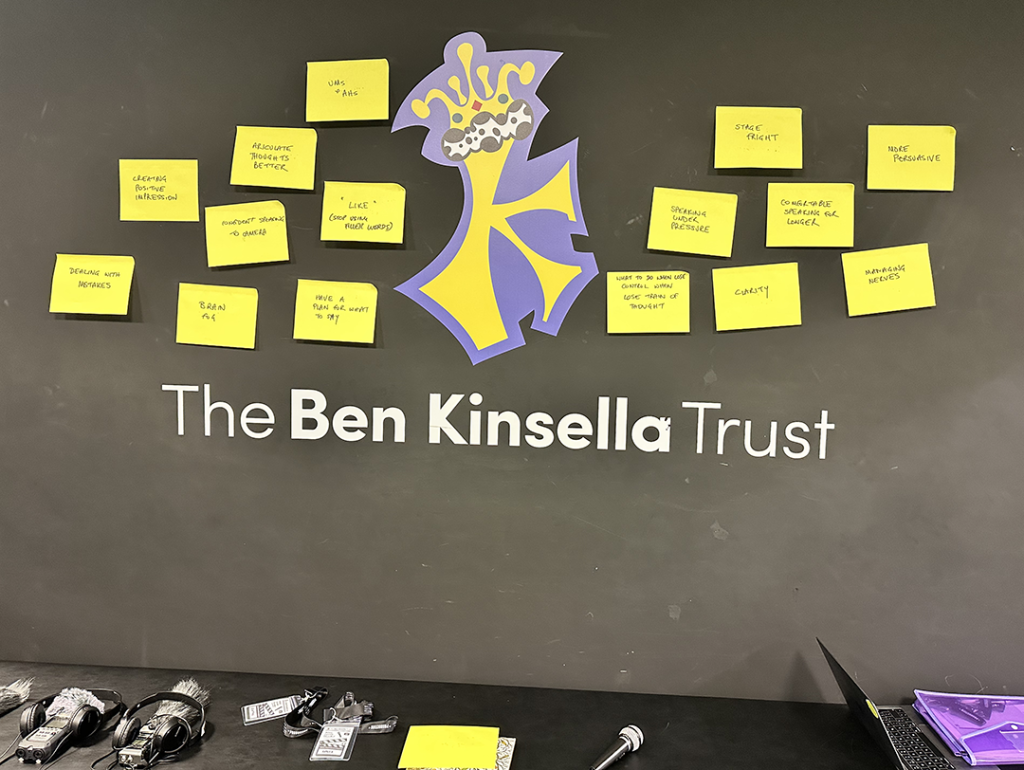
Wall of questions from participants at a Make (Good) Trouble media training workshop. They included how to speak clearly, having a plan for what to say, speaking under pressure and dealing with stage fright.
What happens in a workshop?
Every session follows the rhythm of a real production day. We start with ice-breakers and improv games that warm up voices and lower the stakes. Then crews get a brief, rehearse, coach each other and try again, swapping roles so everyone has a turn. We finish with crews sharing what they’ve made and reflecting on how far they’ve come.
What do young people learn?
The Green Room Framework builds the physical, linguistic, cognitive, and social and emotional skills that make up oracy, plus the confidence and teamwork underneath them.
| Oracy strand | How the Green Room builds it |
| Physical: voice, body language, presence | Improv warm-ups, mic and camera work, performing their finished piece |
| Linguistic: choosing the right words | Writing questions, telling stories, adapting for an audience |
| Cognitive: organising and reasoning | Planning a brief, structuring an interview or speech, responding to follow-up questions |
| Social and emotional: listening, empathy, confidence | The Producer role, HEAR, Producer’s Notes, working as a crew |
Alongside these, young people gain work-ready skills: collaboration, giving and taking feedback, creative problem-solving, and a taste of how the media industry really works. And everyone leaves with something they made.
How long are the workshops?
We’re flexible on timing and will fit around your timetable. You might want a lesson or double lesson each week across a term, or an intensive half day, full day or two days. Schools don’t yet know how much time they’ll be expected to give to oracy, so we’ll work with you on whatever fits.
| Format | Good for | What it includes |
| Weekly sessions | Building oracy into the timetable over a term | A lesson or double lesson each week, with crews working on a project, rotating roles from session to session and finishing On Air |
| Short session – up to half day | A taster, or a focused boost before an event | Warm-ups, one brief, and a round of Trio roles ending in a short On Air sharing |
| One day | Building core skills with one group | A full production day, where every young person plays every role and crews finish with a recorded or live piece |
| Two days | Deeper progress, or groups who need more time to settle | A bigger project or two briefs, more time to rehearse and refine, and a final showcase |
Optional extras include a showcase for parents or staff and professionally edited recordings of the young people’s work.
The cost depends on the length of the workshop, the preparation involved and the number of young people taking part. Get in touch to tell us what you have in mind.
Inclusive by design
Every young person deserves the chance to be heard, so we design our workshops to work for everyone. We have experience working with young people with SEND and home-educated young people.
The Green Room Framework flexes because the structure is simple and the roles offer different ways to shine:
- Different ways in. Some young people come alive as the Interviewee; others find their confidence as the Producer, listening and noticing before they speak. Nobody is pushed into the spotlight before they’re ready. Young people who are non-verbal, or who really don’t want to speak, can still play a full part in the crew: planning the questions, working the mic or camera, or giving Producer’s Notes in writing, drawings or symbols.
- A clear, predictable structure. The same roles and session rhythm every time, so young people know what to expect.
- Flexible formats. Contributions can be spoken, recorded, drawn or scripted, with visual prompts and sentence starters.
- Small crews, safe space. Working in threes means less pressure than performing to a whole room, and every voice gets airtime.
Before every workshop, we talk to you about the group and plan around any access, sensory or support needs. We adapt the pace, the group size, the activities and the breaks. If a young person would benefit from extra support, a trusted adult they already know can join the session. A familiar face can help them settle in and feel safe enough to have a go.
One parent whose son has ADHD and autism told us that our holiday drama club had become one of his safe places. Over the years, they’ve seen him become more confident, more positive and better at dealing with tricky situations.
Safeguarding and wellbeing
- All our facilitators hold enhanced DBS checks, and our team includes a safeguarding lead and first aider.
- We carry out a risk assessment for every workshop.
- Our workshops are a safe, supportive space, with emotional support alongside the practical work.
- Read our safeguarding policy.
What does your organisation get?
Every organisation gets young people who are more confident speaking up, and something to show for it: podcasts, films, interviews and speeches they made themselves. Here’s what else we offer you.
- Schools, colleges and universities: a session plan built around your needs and your timetable, practical support for oracy ahead of the new framework, and options for special schools and alternative provision. For universities, we work with outreach and widening participation programmes.
- Youth clubs and youth groups: a fun, memorable session young people want to come back to, that builds confidence and teamwork. This works just as well for uniformed, sports and faith groups.
- Charities and CICs: youth ambassadors, youth councils and young advisers ready to speak up in consultations, panels, campaigns and the media.
- Home education groups: a ready-made way to build speaking and listening skills, in person or online, for groups or individuals.
- Councils, public health and the NHS: young people prepared to take part in participation and youth voice work, so their views shape the services that affect them.
- Employers and work experience programmes: young people who can introduce themselves, ask good questions and present their ideas, ready for interviews and the workplace.
What people say
“They created such a relaxed, welcoming space for the youth researchers to have their voices heard and express themselves creatively.“
— Gemma Neathey, Senior Participation Officer, Surrey Youth Voice, Surrey County Council
“I was most impressed and excited about working with Make (Good) Trouble because they all have enthusiasm, skills and access to ways of communicating with young people that we haven’t got right. They come with solution ideas. It is great.”
— Kerry Clarke, Children, Young People and Public Health Schools Commissioner and NHS Local Authority Adviser
“The reason that I absolutely am mortified by public speaking is because I get so much anxiety. I get really hot and sweaty. I feel like everyone’s noticing it, so I feel super embarrassed, and so I used to avoid it at all costs. … Daisy was amazing because she would help me work at it. And what I learned is that it does take a lot of hard work and actually wanting to be better. We did breath exercises, we practised a little speech that I prepared multiple times. She’d give me pointers, tell me when I was speeding up too much, all these little things, and it was just mainly practice, practice, practice until it’s like super in your body.”
— Mose, student at Liverpool John Moores University
Oracy workshop FAQs
What is the Green Room Framework?
It’s Make (Good) Trouble and Dragon Drama’s approach to oracy. Young people work in crews of three, taking turns as producer, interviewer and interviewee to make a real media project, and coach each other using four simple listening habits we call HEAR. It works because, unlike workshops where young people practise someone else’s script, they choose what to make and what to say. They own the content, they’re invested in getting it right, and they’re working in a small crew that has their back, so they feel safe enough to have a go.
How long is an oracy workshop?
It’s up to you. We can run a lesson or double lesson each week across a term, or an intensive half day, full day or two days. We shape the length and content around your group and what you want to achieve.
What ages are the workshops for?
Young people aged 10 to 18.
How many young people can take part?
Up to 30 young people, working in crews of three.
Are the workshops suitable for young people with SEND?
Yes. We have experience working with young people with SEND, and we plan every workshop around the group’s access, sensory and support needs.
Do you work with home-educated young people?
Yes. We run workshops for home education groups and co-ops, as well as schools and youth organisations.
What if a young person is shy or anxious about speaking?
That’s exactly who these workshops are for. We start with games and play, so nobody is put on the spot. Many quieter young people find their confidence first as the Producer, listening and coaching, before they step up to the mic at their own pace.
How do the workshops link to the new oracy framework?
The government is introducing a new oracy framework to help schools in England teach speaking and listening. Our workshops build the same skills, and give schools a practical, enjoyable way to support oracy now.
Where do you run workshops?
Across England, at your school, setting or venue, or online.
How much does a workshop cost?
It depends on the length of the workshop, the preparation involved and the number of young people. Get in touch and we’ll give you a price.
How do you look after young people’s wellbeing?
All our facilitators hold enhanced DBS checks, we risk assess every workshop, and we create a safe, supportive space with emotional support alongside the practical work.
Ready to help your young people find their voice?
Tell us about your group and what they need, and we’ll shape a workshop around them.
You might also like: Media training workshops · Creative workshops · Holiday drama club · Dragon Drama · The new oracy framework: Why speaking up matters for young people